Lionfish
2 Photo Gallery

1 Species Overview
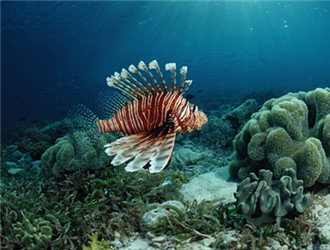
Lionfish, also known as the turkeyfish or zebrafish (蓑鲉, Pterois), is a fairly common ornamental marine fish. Its appearance is highly distinctive, and its fin spines carry venom glands—being stung by a lionfish causes severe pain, and in serious cases can lead to difficulty breathing and even fainting.
Kingdom: Animalia
Phylum: Chordata
Subphylum: Vertebrata
Class: Osteichthyes (bony fish)
Order: Scorpaeniformes
Family: Scorpaenidae
Genus: Pterois
Chinese name: Lionfish (狮子鱼)
Other names: turkeyfish, zebrafish (蓑鲉)
Distribution: Indo–West Pacific warm-water seas, mostly found among rocky reefs and coral.
2 Appearance
The lionfish is the common name for marine fishes of the subfamily Pteroinae (family Scorpaenidae, order Scorpaeniformes). Their hallmark is a huge, fan-like pectoral fin. Lionfish also pose a threat to humans: the spines on their dorsal fin are venomous, and in severe cases a sting can cause a person to faint.
There are roughly 13 genera and over 150 species of lionfish; China has 1 genus with 4 species. Body length can reach 450 mm. The body is elongate, with the front part sub-cylindrical and the rear gradually compressed and narrow. The head is broad, large and flattened. The snout is broad and blunt. The eyes are small and on the upper side. The mouth is terminal, with the upper jaw slightly protruding. The gill opening is medium-sized. The body is scaleless; the skin is loose and soft, smooth or with small granular spinules.
The dorsal fin is elongated, continuous or with a notch; the fin spines are slender and similar to the soft rays. The anal fin is elongated; the caudal fin is truncate or rounded, often connected with the dorsal and anal fins. The pectoral-fin base is broad, extending forward to the throat; the pelvic fins are thoracic and fused into a sucker. Lionfish feed mainly on crustaceans and also eat small fish. The most abundant species in China is the fine-lined snailfish (细纹狮子鱼).
The lionfish’s fins are large, but it is not a strong swimmer; it often hides in reef crevices and strikes the moment prey comes close. The dorsal fin bears venomous spines normally enclosed in a membrane; when threatened, the membrane tears and the spines are used to attack.
3 Tank & Habitat
Once you have picked a healthy lionfish, you can start preparing for captive care. When selecting a lionfish, check for wounds on the body and confirm that its swimming posture is normal. When handling your lionfish we recommend wearing gloves to avoid being stung.
Recommended water parameters for lionfish: temperature 26–27 °C, specific gravity 1.022–1.023, seawater pH 8.0–8.5, hardness 7–9 °dH. Foods include frozen fish and shrimp meat, tubifex worms, and marine fish pellets. The fish’s fin rays are venomous and it is an expert at camouflage, rapidly matching its body color to the surroundings, so it should not be kept with small fish.
4 Feeding
Because the lionfish is a marine fish, being moved into captivity and the resulting environmental change can make it uneasy; while adjusting to the new surroundings it will often hide. Occasionally, after a change in environment a lionfish may also refuse food.
The lionfish is carnivorous; in captivity it can be fed animal-based foods and prepared feeds. It will eat small fish, shrimp and the crustaceans in the tank. When a lionfish is first introduced to the aquarium, use live brine shrimp to tempt it to start feeding. Foods include various animal-based items such as live shrimp and live fish, with crustaceans offered from time to time.