Common Hatchetfish
2 Photo Gallery

1 Breed Profile
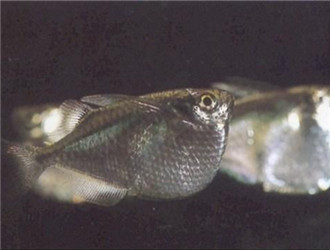
The Common Hatchetfish is best known for its protruding, belly-like abdomen and is one of the more common ornamental fish. Gentle and a surface-dwelling species, it suits tanks with floating plants.
Chinese name: Silver Hatchetfish
Binomial: Gasteropelecus sternicla
Also known as: Common Hatchetfish
Kingdom: Animalia
Origin: South America
Reproduction: oviparous
Water: pH 5.8-7.5
Care level: difficult
Suitable temperature: 23-30 C
2 Appearance
The Silver Hatchetfish is the only ornamental fish that can ‘fly’; unlike the flying fish, it rapidly beats its pectoral fins near the surface and has a habit of jumping out of the water.
Its shape resembles a hatchet, strongly compressed and very thin. The back is nearly straight; the chest and belly protrude in a deep arch. The head is small; the eye is slightly large, near the dorsal edge. The dorsal fin is small; its start is farther from the snout than from the caudal base; the pectorals are well developed, extending into filaments; the anal base is very long, the caudal peduncle short; the caudal fin is shallowly forked, slightly rounded at the tip. The whole body is silver-white with markings, and a faint brown pattern on the dorsal. Length 5-7 cm.
3 Husbandry
Its pectoral fins are especially large, letting it leap at the surface. At 5-7 cm, the tank must be covered to prevent jumping out.
It often swims at the surface and is schooling. Plant the tank heavily, preferably with floating plants. Because of its strong jumping ability, cover the tank. It likes slightly acidic soft water, 23-30 C, pH 5.8-7.5, and feeds mainly on animal matter. Breeding is difficult; it spawns on fine-leaved plants.
4 Feeding
Gentle and somewhat shy, all silver-white, its main feature is ‘flying’ at the surface. What is special about feeding this unique fish?
It likes live food floating on the surface and will not take sinking food; feed with flakes, or floating artificial pellets or bloodworms. Best kept in dimmer light with plants. When sleeping, its brain rests while its body drifts slowly in the water.