
Varanus rudicollis
Reptiles
The roughneck monitor is distinguished by its slender snout, which becomes progressively rounder as it grows; adults develop a jaw shape reminiscent of a beast of prey. Adults can reach a total length of up to 146 cm.

Phormictopus cancerides
Reptiles
The Haitian brown tarantula (Phormictopus cancerides), also known as the Dominican blue tarantula, is native to the tropical rainforests of Haiti and Brazil. It is one of the classic pet tarantula species kept by enthusiasts.
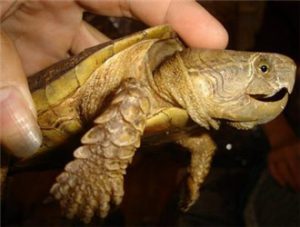
Big-headed Turtle
Reptiles
A bizarre, hook-beaked Asian turtle with a huge triangular head it cannot retract - wild-caught and protected, so captive-bred-only and for specialists.
 Most mud turtles 10–16 cm (4–6 in); giant musk turtles 25–40 cm (10–16 in); smallest musk species under 15 cm (6 in)
Mud and Musk Turtles (Egg Turtles)
Reptiles
The 'egg turtle' is not a single species but the common nickname for the family Kinosternidae — mud turtles and musk turtles — named for their smooth, egg-shaped carapace. Mostly North American, they are popular, interactive pets, but each species differs in size, care difficulty and husbandry, so research the exact species before buying.
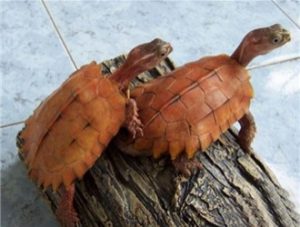
Black-breasted Leaf Turtle
Reptiles
A tiny, leaf-shaped turtle from southern China and Southeast Asia, famous for its golden carapace with twelve keels and notorious for being one of the hardest chelonians to keep.

Red-banded Snake
Reptiles
A black-and-red banded colubrid of East Asia - gentle in captivity, with a red 'A' mark on the nape. Technically a mild rear-fanged snake; practically harmless.
 Commonly 4–5 m (13–16 ft) in captivity; records up to 7 m (23 ft)
Golden Python
Reptiles
The Golden Python is a patternless, leucistic morph of the Burmese python (Python bivittatus), prized for its uniform golden-cream coloration. Wild-type individuals cannot survive in nature due to a lack of protective melanin, so every specimen in captivity is captive-bred. A large, heat-loving constrictor, it needs steady temperatures of 26–33°C, regular soaking to aid shedding, and a diet of whole rodents or rabbits.

Banded Krait
Reptiles
A strikingly banded, highly venomous elapid of southern China and Southeast Asia - beautiful but dangerous; not a pet and a poor choice for novices.
Want to Learn More About Breeds?
Browse our pet health Q&A knowledge base for breed-related care advice and health information
View Q&A Knowledge Base →