Banded Krait
2 Photo Gallery

1 Overview
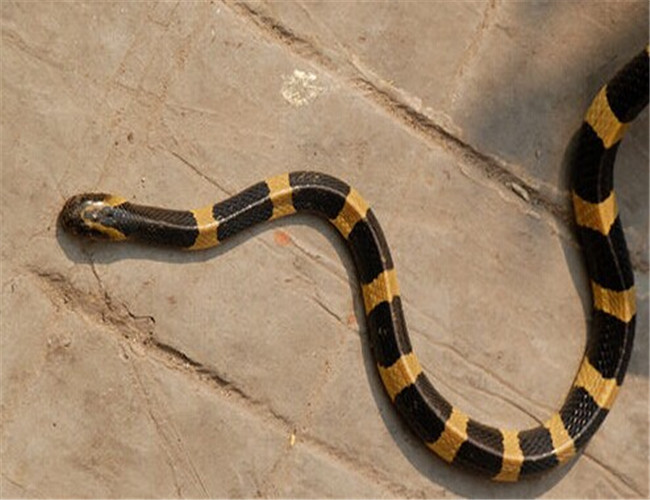
The banded krait (Bungarus fasciatus) is a strongly venomous elapid with bold black-and-yellow bands. It is generally not aggressive to humans and its venom is weaker than its relative the many-banded krait, but it remains a deadly snake and is more numerous than that species.
CONSERVATION / SAFETY NOTE: highly venomous (neurotoxic). We do not recommend keeping it; novices especially should avoid it. It is also a wild-food species, which drives collection.
2 Appearance
The head is oval, the tail very short and bluntly triangular; the body shows nearly equal-width black and yellow rings (23-28 on body, 3-5 on tail). Smooth dorsal scales in 15 rows, with the central row enlarged; the body cross-section is triangular. Length 100-180 cm. A pale inverted-V marks the nape.
3 Habitat & Environment
Hatchlings need a snake box above 15 C; adults brumate. Not for beginners despite a calm daytime temperament – the venom makes handling unsafe. In autumn they build fat reserves; in winter keep the den at 11-13 C, ~10% humidity, with sun-baked soil for safe hibernation and a post-wake sunbath. Summer needs shade over pools to avoid overheating.
4 Diet & Feeding
A carnivorous predator that prefers live prey; wild ones hunt at night and rest by day. Hatchlings live on yolk for ~10 days, then take chopped eel/loach; weak ones can be tubed. They tolerate long fasting if given water. Rear young separately by species and size to prevent cannibalism; warm with a 200 W lamp in cold snaps. Adults do well with frogs/lizards released in the enclosure.