Ram cichlid
2 Photo Gallery
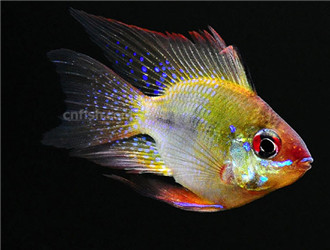

1 Ram Cichlid Species Profile
The Ram Cichlid originated from the Venezuelan Rainbow Cichlid and was developed into the Ram Cichlid after refinement in the Netherlands and Germany. It belongs to the same genus as the Bolivian Ram, but the Ram Cichlid is more brightly colored and is very popular among aquarists.
Chinese name: Dutch Phoenix
Also known as: Ram cichlid
Subphylum: Vertebrata
Order: Perciformes
Family: Cichlidae
Species: Mikrogeophagus ramirezi
Distribution: Orinoco River basin in Colombia and Venezuela, South America
Binomial: Mikrogeophagus ramirezi
Phylum: Chordata
Class: Actinopterygii
Suborder: Labroidei
Genus: Mikrogeophagus
Subspecies: Dutch Phoenix
2 Ram Cichlid Appearance
The Ram Cichlid has very beautiful patterns, and in the aquarium you can see them flash like gemstones. It is popular because it has characteristics different from other ram cichlids—so what are its features?
Adult fish are 6 to 9 cm long. They belong to the same genus as the Bolivian Ram but are more brightly colored, with killifish-like patterns on the body and a gem-like shimmer. The male has beautiful red edges on its fins. The black spot on the back combined with the red eyes is strikingly beautiful. When the male spreads the four black spines on its dorsal fin it is very handsome.
They are gentle, small, and lively, swimming almost all day in the aquarium. They are easy to keep and can be mixed with other species. In daily care, place some pebbles at the bottom to keep the water clear. Males are slender, active, and darker; females have a swollen abdomen, sway as they swim, and are paler.
3 Ram Cichlid Habitat and Care
The Ram Cichlid has always been a very popular species and is the top choice for beginners starting with dwarf cichlids. Although it is one of the easier dwarf cichlids to keep, you still need to pay attention to proper methods and the breeding environment.
The Ram Cichlid is a dwarf cichlid that likes neutral, slightly acidic soft water, pH 6 to 7, temperature 25 to 28 C, and is very sensitive to chemicals. Maintaining good water quality also helps prevent popeye and dropsy. It can be kept in pairs or as a single sex; because of its territorial nature and intraspecific fighting, ensure each pair has a territory of about 40 cm square, with a complex environment and not-too-strong lighting. You can place driftwood and plant shade-tolerant species to give them hiding places and for breeding.
Breeding the Ram Cichlid is very simple—just select a healthy male-female pair and you will usually see spawning without difficulty. Do not change water during breeding, and it is best to have a sponge filter in the tank to maintain water quality. During courtship both sexes become more vivid than usual; the parents shake their heads rapidly in small movements, like tapping. They spread all their fins and display in circles. The female’s ovipositor protrudes, and the male defends a territory, allowing only his paired female to enter.
Before spawning, keep the environment quiet and remove other fish if necessary. After the female becomes receptive, she cleans a ‘nursery’ on the chosen spawning site (driftwood, rock, broad-leafed plant surface, small pit in the substrate, etc.) while the male stays by her side. This usually leads to spawning within a few hours. The female lays 80 to 300 eggs at a time.
4 Ram Cichlid Feeding
The Ram Cichlid is very beautiful and is known as the ‘King of Dwarf Cichlids,’ but how can you keep it well? Besides lighting, are there particularities in choosing and feeding food to maintain its color?
The Ram Cichlid is fairly omnivorous and accepts both prepared foods and live food. Prepared foods can be flakes or pellets; it is not picky about live food, but make sure live food is thoroughly disinfected and frozen food is of good quality, and thaw frozen food before feeding, because this fish is prone to intestinal and parasitic diseases. During breeding, boost nutrition—bloodworms and brine shrimp are good choices.