White Corydoras
2 Photo Gallery
1 Breed Profile
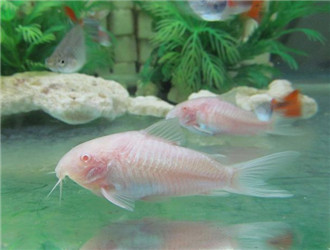
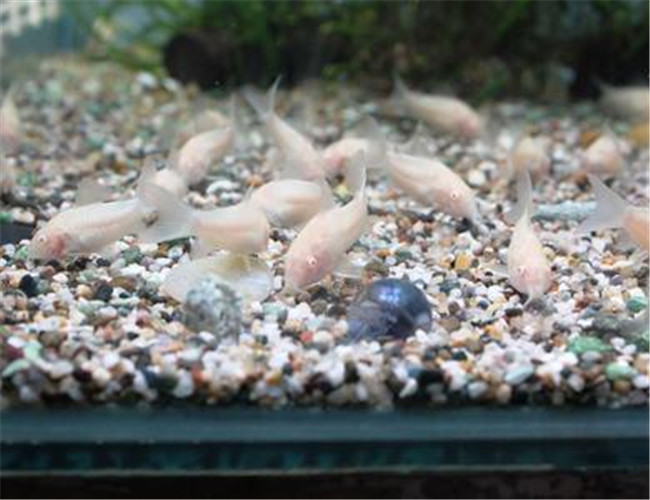
The White Cory (albino form of the Bronze Cory) is native to South American waters, now mostly captive-bred. Milky white body, clear red eyes, gentle, kept in schools. Egg-laying, good with small fish, suits planted tanks with driftwood, a bottom fish. Use fine dark substrate to protect barbels. Like plecos it has bone plates; the first ray of pectoral and dorsal is a spine for defense, but unlike plecos its side plates are equal upper/lower hard scutes, dense and regular. It can also use its vascular hindgut to breathe surface air, surviving drought or low oxygen – why you see it gulp air at the surface.
Chinese name: White Cory
Kingdom: Animalia
Genus: Bronze Cory
Distribution: Waters of South America
pH 7.3, H 12, T 24 C, L 7 cm, V 40 L
Diet: omnivorous
2 Husbandry Requirements
For breeding, a ~40 L neutral tank with 6 fish (2 female, 4 male), sand and plants, a smooth stone. Use moss, driftwood, or rocks for hiding. Avoid substrate! Bare-bottom raises fry survival. Raise temp to 26-30 (mimic dry season). No predators. More fish and bigger tank better (proportioned). Male releases sperm first, female eggs after; eggs stick to plants, rocks, glass, even filter outlet.
In a planted tank keep pH 7 neutral, which corys like; they like new water, so change often – every 3-4 days 1/3 or 1/4. They like hiding spots: rocks, driftwood, moss; skip substrate.
3 Appearance
Native to South America, mostly captive-bred; albino Bronze Cory, milky white, red eyes, gentle, schooling. Egg-laying, good with small fish, planted tanks, bottom fish. Use fine dark sand for barbels. Scale-less, fears salt and medicine, so avoid stabilizers/methylene blue unless necessary, and halve any treatment dose. Many mysteriously die thin-bellied from starvation – bottom dwellers often miss food; feed sinking food like bloodworms, hamburg.
Most corys show no sex color difference, but males often show brighter patterns. Buy one dull fish with two bright. From above, female widest at just before pelvic; male widest at pectoral/just after. From side, female rounder, male slimmer and streamlined.
4 Care
Active at bottom; substrate 1-2 cm helps hiding and makes corys feel safe, also grows nitrifying bacteria and shows cute sifting. Use fine sand (US silica or similar), avoid sharp sand to prevent barbel damage and infection.
1. Medication
Scale-less, fears salt/medicine; avoid chemicals unless necessary, halve treatment dose.
2. Feeding
Many mysteriously die thin from starvation; bottom, gentle, miss food; feed sinking food like bloodworms, hamburg so others eat yet corys don’t starve.
3. Substrate
Aesthetic substrate plus corys’ love of digging causes a problem: sharp edges (e.g. black gold) cut barbels; choose fine, non-sharp sand to avoid loss.
4. Temperature
Some corys are delicate, fear heat (e.g. Emperor, Space Shuttle); southern owners prepare cooling, best ~26 C, or keep hardy types like Panda, Bronze, White.
5. Disease prevention
1. As above, corys fear salt/medicine; avoid illness via food, water, quarantine. Use safe food: frozen bloodworms, hamburg, compound feed – low bacteria/parasite risk; avoid dirty tubifex.
2. Regular water change for clean water; red spots or fin rot signal bacterial disease from poor water.
3. Quarantine new fish with potassium permanganate/yellow powder, but for White Corys that is fatal; instead isolate 1-2 weeks and add only if healthy.
5 Feeding
Least worry: they will not get internal parasites from dirty food. Feed frozen artemia, frozen bloodworms, fresh tubifex, and JBL cory tablets. Sex is clear after maturity: females slightly fuller, visible from below; females’ pelvic fins short and round-tipped, males’ long and sharp. Females merge pelvic fins when spawning to hold eggs until placing them.
Accept many foods; vary: artemia, frozen bloodworms, tubifex, flakes, pellets. In community tanks ensure they eat; use sinking cory tablets or blocks so others do not eat first.