Leaf Fish
2 Photo Gallery

1 Breed Profile
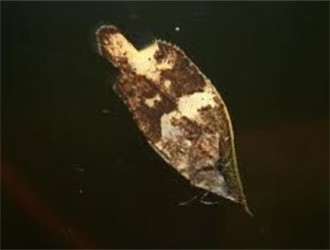
The Leaf Fish, also called the Dead-leaf Fish, Leaf Fish, or Many-spined Leaffish, is native to the Amazon River and Guyana. Its form is so unusual that when motionless on the bottom it is almost indistinguishable from a leaf fallen into the water.
Chinese name: Leaf Fish
Binomial: Monocirrhus polyacanthus
Also known as: Dead-leaf Fish; Leaf Fish; Many-spined Leaffish
Kingdom: Animalia
Order: Elopiformes
Family: Monocirrhidae
Distribution: North America; Europe
2 Appearance
As its name suggests, when the Leaf Fish lies motionless on the bottom it is almost indistinguishable from a leaf that has fallen into the water. If you net it and it still does not move, you would only notice it by picking out the leaves caught in the net.
The adult Leaf Fish reaches about 10 cm. It is deep-bodied and strongly compressed, much like a leaf. The snout is pointed. The mouth is large with a downward-slanting gape; the lower jaw protrudes and bears a hard barbel. The eyes are positioned high and on top. The dorsal and anal fins have long bases extending to the caudal peduncle, with more spines than soft rays.
The pectoral fins are small; the pelvic fins sit just forward of and below the pectorals. The caudal peduncle is short and small, and the rounded caudal fin is poorly developed. The body color changes with ambient light, appearing green or dried-yellow, camouflaging as a fallen leaf drifting in the water – both evading predators and ambushing prey such as small fish and insects. It is a precious fish with remarkable camouflage ability.
Its movement is also strange: in the water it seems to drift with the current without any swimming motion. Only on close observation does one notice the frequent tiny fin beats; the fins are small and transparent, almost invisible as they move.
Initial knowledge of this fish came from its protruding tooth plates. The rounded central teeth are the largest, arranged in uneven longitudinal rows. Their sides bear long, small crowned teeth, while the edges have even smaller, nearly concentric teeth, some pebble-shaped.
3 Husbandry
The Leaf Fish is rarely kept in captivity, though some aquarists keep it. For captive care, a temperature of 25-28 C, pH 6.0-6.5, and hardness of 5-10 dGH are recommended.
The Leaf Fish prefers 25-28 C. It often stays in the upper water layer and at the surface, remaining motionless for long periods, slowly approaching its target before a sudden strike. It should not be kept with small fish. The eggs are adhesive, sticking to stones or plant leaves; remove the female and leave the male to guard the eggs. Because fossils of this fish have also been found in lagoons and slightly brackish sedimentary rock, it is thought able to survive in waters of varying salinity.
4 Feeding
With its unique appearance, the Leaf Fish should not be kept with small fish and is best kept alone. It prefers live food and ambushes by surprise. It is recommended to decorate the aquarium with plants and driftwood.
The Leaf Fish lives by preying on smaller fish and insects. Its hunting method is distinctive: it may lie in the water for an hour, a day, or even longer without moving. When prey approaches, it carefully judges the size and strength; if the target is even slightly larger or aggressive, it would rather keep waiting than risk contact. For a target it deems attackable, it launches a sudden strike and captures the prey with near certainty.