Rosy Barb
2 Photo Gallery

1 Species Overview
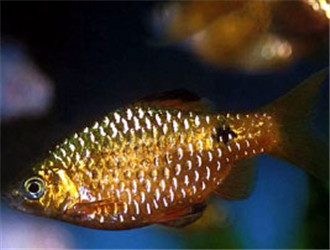
The rosy barb is native to India. In the aquarium it usually reaches 5 to 7 cm, but in the wild it can grow to 14 to 15 cm. During breeding it shows a striking nuptial coloration.
Distribution: China
Body shape: Fusiform (spindle-shaped)
Chinese name: Rosy barb
Latin name: Puntiusconchonius
Kingdom: Animalia
Genus: Puntius
2 Appearance and Physical Traits
The rosy barb is a common ornamental fish, native to India, lively and sociable, but it may bully smaller fish, so do not keep it with other small ornamental fish.
The body is fusiform, 5 to 7 cm long (up to 14 to 15 cm in the wild). Juveniles are silvery white; as they grow, the back turns silvery white and the upper side yellow-green, with a black round spot on the rear body and a black spot on the dorsal fin. During breeding the nuptial color appears: males turn wholly rose-red, bright and beautiful. The sexes are easy to tell: males are narrow with large fins and brilliant nuptial color; females are paler and darker, broader and thicker, with a swollen belly.
3 Habitat and Living Environment
For the rosy barb, water changes are very important. Only by tuning the water can you give it a stable home and raise healthy, pretty fish. It tolerates lows of 16 C and prefers 22 to 25 C. It likes neutral water.
A full water change replaces all the water and is the simplest effective way to change quality, but it is laborious, especially with decorations. Before changing, cut all electrical power, remove fish and decor, drain, rinse the tank, reset the decor, and add new water.
A partial change (topping up) is the handy method used often. Beforehand, turn off heaters, pumps, and filters, then wipe the glass and decor free of algae with gauze. After 15 minutes the suspended matter settles; gently siphon the bottom dirt with a rubber tube, removing about one-quarter to one-third of the water. Then slowly add prepared new water of the same temperature along the glass wall.
4 Feeding Guidelines
Feed the rosy barb by its size. Generally give 2 to 3 meals daily; during breeding, 3 to 4 daily. Keep feed eaten within 10 to 30 minutes.
Keep temperature at 24 to 28 C, within which appetite is strong and growth fast, unaffected by outside temperature. Foods include daphnia, tubifex, threadworms, mealworms, small live fish, and pellets. Rosy barbs vary in size, so food choice differs. For fish 3 to 12 cm, feed mainly daphnia with tubifex, bloodworms, and mealworms as supplement. For fish over 12 cm, daphnia is too small and poorly palatable, so choose larger foods: bloodworms, tubifex, mealworms, small live fish. Most barbs eat mainly animal food; small varieties can be trained onto pellets, while few eat mainly plant food.