Zhou’s Box Turtle
2 Photo Gallery
View All 7 Photos


1 Overview
Zhou’s Box Turtle is scarce, found in China only in Guangxi and Yunnan, and is a relatively precious species. It occasionally appears in the market, but wild resources are nearly depleted. Little research exists on its wild state; the only available information comes from accumulated captive husbandry experience.
Chinese Name: Zhou’s Box Turtle
Alternative Names: Black Box Turtle, Black Turtle
English Name: Zhou’s Box Turtle
Binomial Name: Cuora zhoui
Kingdom: Animalia
Phylum: Chordata
Subphylum: Vertebrata
Class: Reptilia
Subclass: Reptilia
Order: Testudines
Suborder: Pleurodira
Family: Emydidae
Subfamily: Geoemydinae
Genus: Cuora
Subgenus: Cuora
Species: Zhou’s Box Turtle
Distribution: In China, mainly distributed in Guangxi and Yunnan provinces.
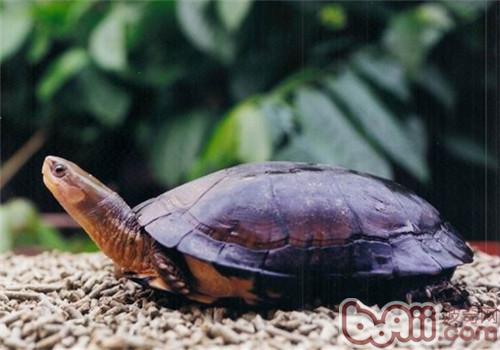
Appearance: The carapace is black or earthy black, oval, with or without a central keel and no lateral keels; the front edge of the carapace is not serrated.
Habits: The habits of wild Zhou’s Box Turtle have not been recorded. But from its morphology, it lives in mountainous areas, mountain streams, and small rivers.
Reproduction: Zhou’s Box Turtle reproduces by oviparity (egg-laying).
Diet: The diet of wild Zhou’s Box Turtle has not been recorded. In captivity it eats lean pork, fish, poultry offal, and small insects.
2 Physical Characteristics
The head of Zhou’s Box Turtle is pale grayish-white, relatively narrow, scaleless on top, with smooth skin; the snout is pointed with a rounded tip. The upper jaw is hooked; the iris is yellow-green; the tympanum is pale yellow. From the nostril through the eye to the back of the head runs one thin pale-yellow stripe, and from behind the eye to the back of the head runs another; the edges of both stripes are bordered with olive-green lines. The neck skin is covered with warts; the back and sides are olive-green, the belly pale gray-yellow. The limbs are slightly flattened, olive-green on the back and pale gray-yellow underneath, with well-developed webbing and claws—five claws on the front limbs, four on the hind. The tail is moderate.
3 Care & Husbandry
The husbandry of Zhou’s Box Turtle hatchlings can refer to that of the yellow-margined box turtle (Cuora flavomarginata); whether in enclosure setup or food selection, the hatchlings are much the same. Starting from hatching, here is how to keep Zhou’s Box Turtle.
Hatchlings Fresh from the Egg Need Temporary Rearing: Newly hatched turtles are delicate and should not be placed directly in a pond; let them crawl freely on fine sand first. Once the umbilical cord dries and retracts and the body straightens from its curl, move them to indoor basins or dishes for temporary rearing. For the first day or two, the yolk is not yet fully absorbed, so no external nutrition is needed. After two days, start feeding water fleas, earthworms, and boiled egg yolk 2–3 times daily, each time until full with none left at the next feeding. After another two days, begin feeding minced fish, shrimp, snails, and mussels. Change the water daily to keep the basin clean.
Husbandry Management of Hatchlings: After a few days of indoor rearing, they can be moved to a hatchling pond. Disinfect with medication before introduction. Stocking density is 50–80 per square meter. Feed should be refined, fine, soft, and fresh, mainly animal-based fish, shrimp, snails, mussels, and poultry offal, supplemented with plant-based melons, vegetables, and wheat bran. If possible, feed artificial compound feed with about 40% protein. Follow the ‘four fixed’ principle: fixed time, fixed location, fixed quality, fixed quantity. Feed once each morning and evening, or once daily when temperatures are low. Change water frequently, 1–2 times daily.
4 Habitat & Environment
In early November each year, as temperatures drop, Zhou’s Box Turtle gradually enters hibernation. At this time, lay 7–8 cm of moist sand in the enclosure and place it indoors in a sunny spot for natural hibernation. In late March of the following year, when the temperature rises to about 18–19°C, the turtle begins to feed; the first feeding should be small and high-quality, and especially after feeding the ambient temperature must not fall below 15°C, or digestive disorders may result.
5 Feeding Requirements
Zhou’s Box Turtle is omnivorous but leaning carnivorous, so when keeping it, provide fresh, high-quality meat such as fish, shrimp, and lean pork. Few keep it on turtle pellets, but it can be tried if the turtle accepts them.
Feeding Tips: In captivity, Zhou’s Box Turtle eats animal-based food—daily feed lean pork, poultry offal, etc. Feeding can occur when the ambient temperature is above 22°C (considering whether nighttime temperatures after feeding stay above 20°C), once daily or every two days. In late autumn when temperatures are unstable, stop feeding earlier; at 20°C feeding can cease, otherwise the turtle is prone to digestive disorders.
Daily Management: Water quality directly affects the turtle’s health. Newly acquired turtles must not be placed directly in fresh tap water; use settled, well, or river water, and switch to tap water only after the turtle adapts. In spring and autumn, change water 2–3 hours after feeding; in summer, within 1 hour after feeding, to keep water clean. Before hibernation, check the turtle’s condition—physical strength, parasites, feces. Only healthy turtles should hibernate. During hibernation the turtle can be kept directly in water, but the level must not exceed the carapace. During hibernation, change water once a month and regularly check the turtle’s condition.