Turnip Moth
2 Photo Gallery
1 Turnip Moth Breed Overview
Red cutworm
The Yellow Cutworm, also called the soil silkworm, ground silkworm, root-cutting worm, or cutting worm, is an arthropod many have seen. In its young stage it is pupa-like, and the adult looks like a butterfly with two wings. Its damage has shown a clear upward trend lately. The larvae usually bite seedlings off at ground level; once the main stem hardens they climb up to attack the growing point. It is distributed in all provinces except Guangdong, Hainan, and Guangxi, where it has not been reported.
Chinese name: Yellow Cutworm
Other names: Soil silkworm, Ground silkworm, Root-cutting worm, Cutting worm
Binomial name: Agrotis segetum (Denis et Schiffermuller, 1775)
Kingdom: Animalia
Phylum: Arthropoda
Subphylum: Mandibulata
Class: Insecta
Subclass: Pterygota
Order: Lepidoptera
Family: Noctuidae
Genus: Agrotis
Species: Yellow Cutworm
Distribution: Nationwide
2 Physical Characteristics of the Turnip Moth
The larva of the Yellow Cutworm is very similar to that of the black cutworm. The main difference is that the mature larva is 33-43 mm long, yellowish-brown, with an indistinct granular surface, glossy, and wrinkled. Each abdominal segment has four wart-like spots on the back, the front two similar in size to the rear two. Below are the specific morphological traits of the Yellow Cutworm.
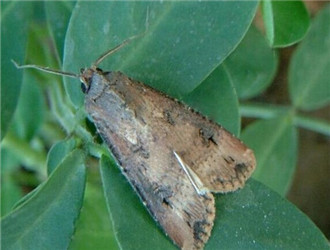
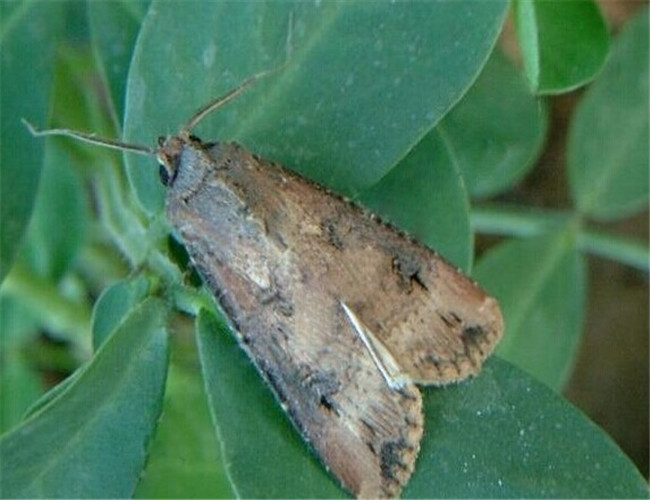
Adult: body length 14-19 mm, wingspan 32-43 mm, gray-brown to yellow-brown. The frons has a blunt conical protrusion with a central depression. The forewings are yellow-brown, scattered with small brown spots; the lines are double curved but mostly unclear; the reniform, orbicular, and claviform spots are clear with fine black-brown edges, the rest yellow-brown; the hindwings are grayish-white and semi-transparent.
Egg: flat-round with a flat base, yellow-white, with over 40 wavy longitudinal ridges, about 15 reaching the micropyle area, and under 15 transverse ridges forming a net-like pattern.
Larva: body length 33-45 mm, head yellow-brown, body pale yellow-brown, granular surface indistinct, wrinkled and pale, with two large yellow-brown spots on the anal plate separated in the middle and many small black dots; abdominal back wart spots, the rear two slightly larger than the front two.
Pupa: body length 16-19 mm, red-brown. The 5th-7th abdominal segments have very dense small pits in 9-10 rows, and a pair of coarse spines at the abdominal tip.