Sulawesi Forest Turtle
2 Photo Gallery
View All 6 Photos


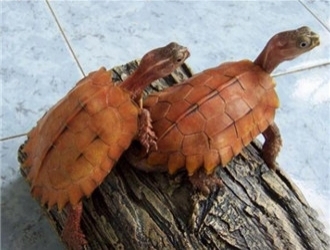
1 Overview
The Sulawesi forest turtle is the only species in its genus, found only in parts of Indonesia. Gentle in temperament, it has a small carapace and is semi-aquatic. It is not demanding about environment or food, yet few keepers in China have it, and it is not easy to buy.
Chinese name: Sulawesi forest turtle
Latin name: Leucocephalon yuwonoi
English name: Sulawesi forest turtle
Aliases: Sulawesi white turtle, Sulawesi ground turtle
Kingdom: Animalia
Phylum: Chordata
Class: Reptilia
Order: Testudines
Family: Geoemydidae
Subfamily: Geoemydinae
Genus: Leucocephalon
Species: Sulawesi forest turtle
Distribution: Northern Sulawesi, Indonesia, near the port of Gorontalo on the Minahasa Peninsula.
Habits: Poor cold tolerance, prefers warmth; hibernates around 15°C and feeds actively around 25°C.
Diet: Omnivorous; in captivity feed strawberries, lettuce, banana, worms, etc. Gentle, does not attack other turtles.
Naming: The genus was described by McCord et al. in 1997; the species came from a local named Frank Yuwono, so the species name honors his surname.
Habitat: Semi-aquatic turtle.
2 Physical Characteristics
The Sulawesi forest turtle’s carapace has three longitudinal keels, the central one widest, the lateral ones thin and short. Between keels is relatively flat, with black lines along them. The front and rear marginal scutes are serrated, the rear especially. The nuchal scute is narrow at front, wide at back; the plastron is black centrally with pale-yellow edges. The plastron front is straight-cut, the rear deeply notched. A deep notch lies between the anal scutes. The front limbs and shanks have large scales; toes slightly webbed; tail short. Males have a gray-white head, females a brown head.
3 Health & Care
The Sulawesi forest turtle is gentle and fairly easy to keep, but even the gentlest turtle goes through an ‘adjustment period’ when newly acquired—not eating, drinking, or moving. What should we do?
1. Selection
When buying, take time to observe and choose, or you may easily get a problem turtle. Before asking staff to take it out, watch its behavior and appearance at the tank. If other shops sell this species, visit several, observe carefully, and compare prices.
Also observe the shop environment—cleanliness and whether other turtles are healthy and active; only well-managed shops have healthy turtles. Once you like one, ask to hold it and check eyes, mouth, nose, carapace, limbs and claws, and tail.
2. New-Turtle Care
A newly arrived turtle is most vulnerable, so leave it undisturbed in a dry, quiet tank, just noting any movement—digging, going to the pool, or sitting still. Do not offer crickets or mealworms yet, to avoid live prey disturbing its calm; at most place cut banana, apple, or tomato in a dish—eat or not, its choice—and provide a dish of clean water.
Also prepare a dim hide (a small shelter is necessary) for resting. Again, during adjustment avoid startling it—tapping the glass, loud calls—and record its daily state to learn its preferences and diet.
4 Habitat & Environment
When changing water, avoid large temperature differences—keep it within about 2°C. Too-cold water easily causes pneumonia. The Sulawesi forest turtle often eats in water, so add a vitamin supplement (from a reptile shop) to the water after changes, so it ingests it while feeding. It also defecates in water, so change water frequently to keep it clean and healthy.
5 Care Guidelines
Offer prey no larger than about one-third of the head. Remove uneaten crickets, as they easily disturb the turtle’s rest. Since the Sulawesi forest turtle is diurnal, feed during the day and avoid evening feeding, especially within two to three hours before lights out, to prevent digestive upset. For fruit, choose fragrant kinds, as its sense of taste is keen and strong scent attracts it to try.