South American Snake-necked Turtle
2 Photo Gallery
View All 9 Photos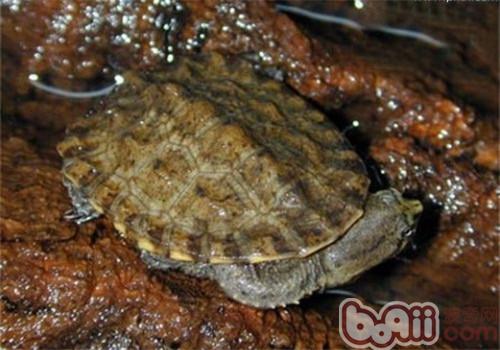


1 Overview
The South American Snake-necked Turtle is the Argentine snake-necked turtle. Snake-necked turtles have long been a favorite, but because numbers are small and they are hard to keep, many want one yet hesitate. On the market the South American Snake-necked Turtle is expensive.
Chinese name: South American Snake-necked Turtle
Aliases: Nail-necked Turtle, Argentine Snake-necked Turtle
English name: South American snake-necked turtle
Latin name: Hydromedusa tectifera
Kingdom: Animalia
Phylum: Chordata
Subphylum: Vertebrata
Class: Reptilia
Subclass: Anapsida
Order: Testudines
Family: Chelidae
Genus: Hydromedusa
Species: South American Snake-necked Turtle
Geographic distribution: Northern Argentina, Uruguay, Paraguay, and southern Brazil.
Reproduction: Oviparous.
Habits: When chasing food it is much like the mata mata, suddenly lunging forward and swallowing food and water together. For it this hunting method is a pleasure, so live fish should be used as food. It does not need much sunning.
Size: Most turtles have a tiny nuchal scute between the first and second marginals, but the South American snake-necked turtle is different, its nuchal larger, behind the first and second marginals and in front of the first vertebral. The bright colors and varied stripes of its head and neck are part of why keepers love it.
Diet: Likes fish and shrimp, occasionally accepting very small amounts of commercial food.
2 Physical Characteristics
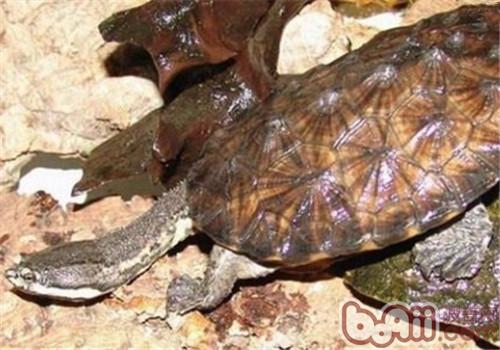
Like all turtles in its genus, the South American Snake-necked Turtle has a long neck that cannot retract into the shell, but unlike others its neck has no spines, so it looks smooth. The carapace is uneven, like a rock.
The South American Snake-necked Turtle’s shell has a strong keel; the head is yellow and black, with black or yellow spots nearby; the neck is longer than other turtles, and the tail is slender. Its form is much like the common snake-necked turtle. Females are generally larger than males, up to 40 cm. Modern science finds the snake-necked turtle among the most ancient living reptiles. Its main traits are a very solid shell, into which it can retract head, tail, and limbs when attacked, a long neck, and a rough shell, especially in the young.
Most turtles have a tiny nuchal scute between the first and second marginals, but the nail-necked turtle is different, its nuchal larger, behind the first and second marginals and in front of the first vertebral. Its head and neck show bright colors and varied stripes. Females are larger than males. Males have a concave central plastron, a deeper anal notch, a long tail, and a cloaca far from the carapace; females have a flat plastron.
3 Care Guidelines
The South American Snake-necked Turtle is not as odd-tempered as it looks; it is actually gentle, but when hunting you see its swift side, usually striking prey dead in one blow like a fast bullet.
I. Hunting traits of the South American Snake-necked Turtle
It chases food much like the mata mata, ambushing or stalking then launching a sudden strike. The mouth is at the front-lower part of the head and opens very wide, and with the thick neck, when fully open it is like a pouch swallowing the prey whole. It hunts by contracting neck muscles to snap the head forward while opening wide to swallow food and water together. Its neck is more than twice that of ordinary turtles, making hunting easier.
II. Dietary traits of the South American Snake-necked Turtle
The South American Snake-necked Turtle is quite easy to keep. It chases food much like the mata mata, suddenly lunging forward and swallowing food and water together, a pleasure for it, so live fish should be the food. It does not need much sunning. It likes fish and shrimp, occasionally accepting very small amounts of commercial food.
III. Breeding of the South American Snake-necked Turtle
Its breeding season has not been widely observed, but it is believed to lay eggs by rivers in spring. The eggs are about 34 x 22 mm, white and fragile. Newly hatched turtles are about 34 mm long with a more wrinkled shell than adults. Like most turtles, no method for captive breeding is mastered, so there are no successful hatching cases yet.
4 Behavior & Habitat
The South American Snake-necked Turtle is among the harder turtles to keep, also called the Argentine snake-necked turtle. The difficulty is its high environmental demands, especially in summer, when overly warm water causes shell rot, a strange phenomenon.
I. Setting up the environment for the South American Snake-necked Turtle
The enclosure can be set with water at 70 to 80 percent of the area and land at 20 to 30 percent, different from the flat-headed and furrowed snake-necked turtles, because the South American Snake-necked Turtle likes to climb out and bask, so land is necessary. For land use large stones, driftwood, or bricks as fully dry areas, with a spotlight above the land. Combined with a reptile UV tube, when it climbs out to bask the spotlight plus UV tube mimics the sun’s heat and UVA/B. Though it can replace sunlight, it is far inferior. Water depth can be 1 to 3 times the carapace length.
II. Suitable temperature for the South American Snake-necked Turtle
The proper temperature is 18 to 25 degrees, but in summer water often jumps to 30 degrees or more. If too hot, the shell easily develops shell rot, likely because its shell is weak against fungi; hot water lets fungi multiply fast, also harming the shell. So cooling the water in the enclosure is necessary.
5 Feeding Requirements
The main difficulty in keeping the South American Snake-necked Turtle is disease prevention; it is the turtle most prone to shell rot and hard to treat, so prevention is the only approach. How to keep it healthy?
In the wild it eats various aquatic insects, snails, and small fish; in captivity feed red meat, organs, fish and shrimp, earthworms, and occasionally turtle pellets. Its feeding style is like the alligator snapper or mata mata, waiting in disguise for prey to approach, then striking fast to swallow, quite interesting to watch.
Its form is much like the common snake-necked turtle, only the carapace is a bit uneven and rough, somewhat like the alligator snapper’s shell. It dislikes sunning, so place shade over the container in direct sun. In captivity maintain water quality and temperature. Suitable water temperature is 18 to 25 degrees; dirty water or high temperature causes shell rot and similar disease.
Many keepers think the South American Snake-necked Turtle rots easily and is hard to keep. In fact it just prefers somewhat acidic water, where acidity helps suppress fungi and reduces shedding, and with that plus a regular soft brush cleaning of the shell once in a while, it is fairly easy to keep.