Search Results
46 results for “saprolegnia”
Can methylene blue be added directly to a fish tank?
Methylene blue can be added directly to the tank; it kills bacteria and parasites and treats fungal water mold, with low toxicity. For tank-wide illness dose the whole tank; for one or two sick fish use a separate bath.
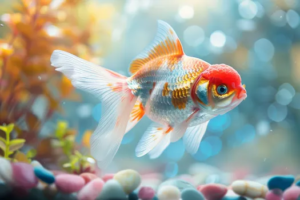
Why Is Your Ornamental Fish Turning White?
When an ornamental fish starts turning white, it is usually a sign of trouble. Common causes include fungal or parasitic infections such as saprolegniasis, neon-tetra disease, or white spot disease; poor water quality with high ammonia or low temperature; unbalanced nutrition; or simply genetics in fish that are naturally pale. Check for lethargy and appetite loss, test and stabilize the water, and feed a proper species-specific diet. If illness is the cause, consult a veterinarian for timely treatment.
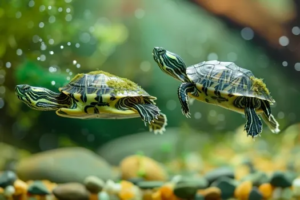
White Fuzz on Your Turtle’s Neck: Shedding or Water Mold?
White fuzz on a turtle can be normal shedding or a sign of water mold disease. If the fuzz has a clear texture with no soft rot, it is likely shedding—just give more sunlight. If fuzz appears on multiple areas and looks rotting, it is probably water mold and the turtle should be isolated and treated. The root cause is usually overcrowding and polluted water; prevent it with good nutrition, wound care, and regular water changes.

Can Water Mold Disease in Turtles Be Avoided? (Causes & Prevention)
Water mold disease is preventable. Although Saprolegnia is widespread in water, its presence alone does not cause the disease—infection requires a wound. A healthy, uninjured turtle will not get water mold, so the key is good husbandry: smooth enclosures, regular sunlight, balanced nutrition, and clean water. Early signs include gray-white spots and white fuzzy growths on the skin and shell; untreated, the disease progresses to swelling, ulcers, appetite loss, and death.

How to Prevent and Treat Water Mold Disease in Turtles
Prevention is the cornerstone of managing turtle water mold, and the root of prevention is avoiding injury—a turtle without wounds rarely develops the disease. Already-infected turtles must be isolated and treated promptly based on their condition. Practical steps include smoothing tank decorations, avoiding mixed-keeping of mismatched turtles, and keeping water stable rather than merely clean. Early isolation and wound care stop the fungus from taking hold.

How to Treat Water Mold Disease in Turtles
Water mold disease in turtles is best caught early, since most medications only work in the initial stage. The two core approaches are raising the water temperature to 28–30°C, which suppresses the fungus, and dry-docking the turtle so the fungus dies without water. For severe cases, antifungal medications such as povidone-iodine are applied topically. Combined with warmth and dry-docking, these methods give the best recovery, while preventing injury and keeping water warm remain the best long-term defense.

How to Treat and Prevent Water Mold Disease in Turtles
Water mold disease (saprolegniasis), caused by Saprolegnia and Achlya fungi, is a common illness in aquatic turtles that usually strikes during overwintering and spring. Infected turtles may lose appetite, grow weak, and develop gray-white patches and fuzzy white growths on the skin; severe cases lead to emaciation, swelling, skin ulcers, and even death from exhaustion. Because the fungus is widespread in water and hard to eliminate, prevention focuses on keeping the turtle injury-free, maintaining water temperature around 28–30°C, and providing regular sunlight. If infection occurs, dry-docking the turtle with short daily soaking, applying povidone-iodine for disinfection, and using a pet-safe antibacterial ointment on affected areas can aid recovery.
What medicine for white fuzz on koi?
It's saprolegniasis (water mold). Isolate the fish, treat wounds with iodine, and dip in potassium permanganate ~5 minutes.

Socolof’s Tetra
Socolof's Tetra is a characin (tetra) ornamental, adults 5 to 6 cm, peach-red in color. A red spot on each lobe of the caudal fin, opposite each other, makes it very beautiful and popular.
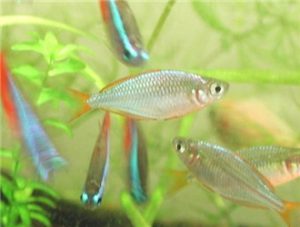
Neon Rainbowfish
The Neon Rainbowfish (Melanotaenia trifasciata) is a small, peaceful tropical fish whose red-edged body glows like a blue ghost under light. It prefers hard, slightly alkaline water at 22-26°C and mixes well with other small fish.