Search Results
1563 results for “cage size”

Brown Shrike
The Brown Shrike (Lanius cristatus), also known as the Red-tailed Shrike, Brown Bush Shrike, Tiger Shrike, and Little Shrike, likes moist habitats, feeds on insects, and occasionally eats a little fresh grass. It is mainly distributed across Siberia, from the Irtysh River and Altai east to the Anadyr Basin and Kamchatka Peninsula, as well as Korea, Mongolia, and Japan; in winter it is also seen in India, Indochina, Malaysia, the Philippines, and Indonesia.
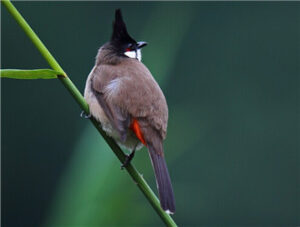
Red-whiskered Bulbul
The Red-whiskered Bulbul (Pycnonotus jocosus) has a wide distribution, mainly in southeastern Tibet, southern Yunnan, southern Guizhou, southwestern Guangxi, and Guangdong in China, as well as India, Nepal, Sikkim, Bhutan, Bangladesh, and Indochina. Each March, Yala Province in southern Thailand holds an annual Red-whiskered Bulbul singing contest, rewarding the winning owner.

Oriolus
The Oriole (Oriolus), also called 'oriole' or 'golden oriole', is the subject of many poems and is very famous. Females are mainly distributed across the tropical Eastern Hemisphere except New Zealand and the Pacific islands. They breed in eastern China and migrate south to India in winter.

Eurasian Siskin
The Eurasian Siskin (Carduelis spinus), also called the yellow bird, is mainly yellow as its name suggests. It is distributed from Europe to Egypt and east to Japan, the Korean Peninsula, and China, living in forests, hills, and plains; in autumn and winter it is more often seen in plains or sheltered foothill belts.
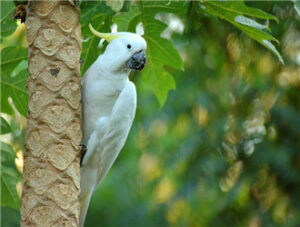
Sulphur-crested Cockatoo
The Sulphur-crested Cockatoo (Cacatua galerita) is beautiful in appearance, but those unfamiliar with it may not realize at first glance that it is a parrot. Its body color is very pale white, and most distinctively it has a yellow crest that fans up like a blooming sunflower when the bird is angry.

Signs a Cockatiel Is Frightened and How to Care for One
Cockatiels are timid and startle easily, reacting with whole-body trembling, restlessness, and cage-bashing. Keep them in a quiet spot, maintain steady temperatures, and feed a mix of corn, sunflower seeds, millet, and cuttlebone for calcium. Comfort and gently stroke the head to calm a frightened bird.

Chinchilla laniger
The Chinchilla laniger (Chinchilla laniger) is native to the Andes Mountains of South America, where it lives in caves and rock crevices at about 1,600 m elevation. Its appearance resembles that of a rabbit and a squirrel. A special feature is its pair of large, bright, ruby-red eyes, which are beautiful.

Yellow-bibbed Lory
In many places few people keep the Yellow-bibbed Lory, but in the Solomon Islands it is a different story: this is the wild habitat of the Yellow-bibbed Lory, and many locals keep them as pets. Visually the Yellow-bibbed Lory is striking, showing red, yellow, green, and other colors, so many are attracted at first sight. Moreover, the Yellow-bibbed Lory is a strong mimic, whistling is easy for it, yet although it whistles often it never seems noisy.

Golden Conure / Queen of Bavaria’s Conure
The Golden Conure has very special plumage: except for green wings, its entire body is golden yellow, dazzling and beautiful. It is one of the rarest, most beautiful, and largest of the conures.

Zebra Finch
The Zebra Finch, also known as the Pearl bird, is small and exquisite with a charming appearance and a soft, gentle call; its looks are as appealing as its name, and its plumage resembles the color of pearls. China imported it from Australia in the 1970s and 1980s, and has since bred varieties such as camel, white, and pied.