Saibei Rabbit
2 Photo Gallery

1 Saibei Rabbit Breed Overview
The Saibei Rabbit is a man-made breed developed from a cross of the French ram rabbit and the Flemish Giant, mainly used for production as a fur-and-meat dual-purpose rabbit. Although breeding ensured reproductive performance, coat quality is not especially excellent—a small regret for the Saibei Rabbit. Its main advantages are large size, fast growth, high fertility, strong disease resistance, low morbidity, tolerance of coarse feed, adaptability, a gentle temperament, and easy management. Its main drawbacks are inconsistent coat color and body shape, to be improved through further selection.
2 Physical Characteristics of the Saibei Rabbit
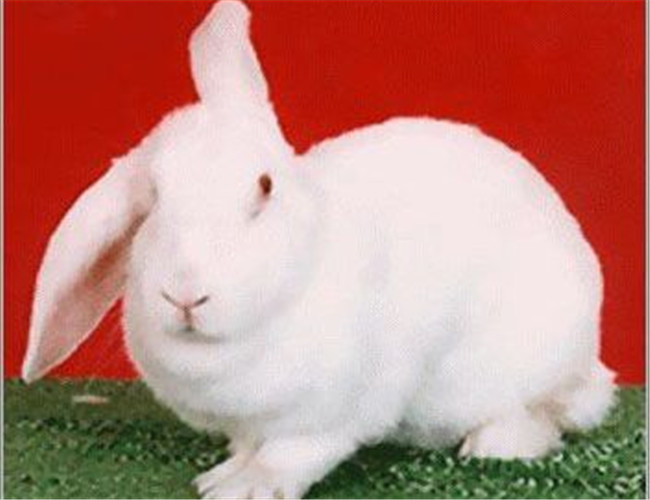
The Saibei Rabbit has a fairly high raising rate in northern China. The breed’s biggest feature is its ears—normally one ear upright and one drooping, the so-called slanted ears; the coat is mostly yellowish.
The breed has three color lines. Line A has yellow-brown fur, with the upper part of the tail-edge guard hairs black, and the tail underside, inner legs, and belly light white; Line B is pure white; Line C is grass-yellow. The breed has dense, slightly long fur; a moderate head; prominent eye sockets with large eyes slightly sunken inward; a broad jaw and square muzzle with a black line on the bridge of the nose; a short thick neck with a dewlap under it; broad sloping shoulders, a wide deep chest, a straight back, a broad hindquarters with full muscles, and sturdy limbs.
The head is moderately proportioned. The orbital arch protrudes, the eyes are large and slightly sunken inward, with a light-black ring of fur around them. The mandible is broad and the muzzle square. The ears are broad and large—one upright, one drooping (slanted ears)—combining upright and lop types. Some individuals in the herd have a peak line on the bridge of the nose. Bucks have a short thick neck; does have a dewlap. Shoulders are broad, chest wide and deep, back and loin straight, hindquarters broad and full, with well-developed muscle and connective tissue. Relatively short and sturdy.
3 Saibei Rabbit Care Tips
Since its successful development and market launch, the Saibei Rabbit has been well received by farmers. It adapts strongly to the environment and is very suitable for rural areas; high litter rate and fast growth are its main advantages.
The Saibei Rabbit was bred by crossing the French ram rabbit with the Belgian rabbit. It is a fine breed suited to rural farming. The Saibei Rabbit has three coat colors—brown, white, and yellow. Its conformation has two types: one ear upright and one drooping, and both ears drooping, resembling the ram rabbit. Observations show that under the same management, the Saibei Rabbit has lower morbidity and higher survival than other breeds. When infected with a virulent Pasteurella multocida strain C5-3 in a same-strain test, the Saibei Rabbit’s resistance was higher than other breeds.
The Saibei Rabbit is large with fast growth. Birth weight 60–70 g, weaning weight at 1 month 650–1,000 g, weight at 90 days 2.1 kg, fattening feed-to-meat ratio 3.29:1. Adult average weight 5.0–6.5 kg, up to 7.5–8.0 kg. It tolerates coarse feed, resists disease, adapts widely, reproduces well, produces 4–6 litters per year averaging 7–8 kits, with an average weaning survival of 81%. As a large rabbit with a looser constitution and big frame, growing fast and tolerating coarse feed, market rabbits are best marketed above 2.5 kg.
4 Saibei Rabbit Living Environment
Some smallholders keep Saibei Rabbits outdoors, while professional farms have a larger environment. So how do you provide a good environment under different conditions?
I. Environmental cleanliness
The Saibei Rabbit’s cage, toilet, and activity area must all be kept clean. As noted, the Saibei Rabbit can go its whole life without a bath—provided the environment is clean.
II. Good ventilation
The room where the Saibei Rabbit stays should be opened to fresh air daily. In deep winter, do not place the cage in a draft, but do not neglect ventilation while keeping it warm.
III. Dry environment
The Saibei Rabbit fears dampness; its living and activity areas must be free of water and dampness. Do not keep it in the bathroom, which should also be off-limits, as dampness triggers many diseases.
IV. Watch dust
Inaccessible places such as under the bed gather dust and must be off-limits to the Saibei Rabbit. Cat litter is too dusty and is not an ideal bedding for the Saibei Rabbit.
5 Saibei Rabbit Feeding Guidelines
For the Saibei Rabbit, the best feed is forage. To save feeding costs, owners can plant forage around the farm, ensuring both annual quantity and nutrition. So how should you plant forage for maximum economic benefit?
The Saibei Rabbit favors Italian ryegrass, Wintergrass 70 rye, alfalfa, sow thistle, hybrid Pennisetum, chicory, and Rumex K-1. Also, sweet potato vines, peanut vines, radish, carrot, cabbage, and greens are good rabbit feeds to use comprehensively. Generally one mu of forage yields about 5,000 kg of fresh grass yearly, enough to raise about 110 rabbits year-round. To give rabbits fresh green feed in all four seasons, arrange planting times well. Three cultivation models are commonly used:
I. Perennial and annual forage rotation
Chicory and Rumex K-1 are perennial forages—plant once and grow 8–10 years. Fresh grass is usable April–November. Usually transplant seedlings in March at 30×50 cm spacing. In mid-to-late October, use the bare rows after cutting these forages to interplant annual Italian ryegrass or Wintergrass 70 rye. Their fresh grass is usable December–April of the next year. In mid-April, clear the Italian ryegrass or Wintergrass 70 rye by the roots, letting chicory or Rumex K-1 grow alone.
II. Annual and annual forage rotation
Plant sow thistle or hybrid Pennisetum in late April; after clearing in mid-September, plant Italian ryegrass or Wintergrass 70 rye; clear again in late April of the next year and replant sow thistle or hybrid Pennisetum, and so on.
III. Annual forage and crop rotation
Use radish or carrot in place of the Italian ryegrass and Wintergrass 70 rye in Model II. You can also use sweet potato in place of the sow thistle or hybrid Pennisetum in Model II. But sweet potato should be planted in early June and cleared in late October; the Italian ryegrass or Wintergrass 70 rye sowing is delayed to late October and clearing to early June of the next year.