Rhinopithecus
2 Photo Gallery
1 Rhinopithecus Breed Overview
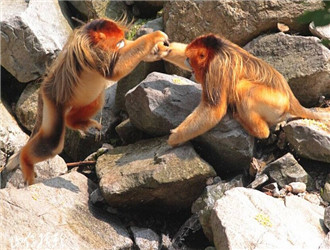
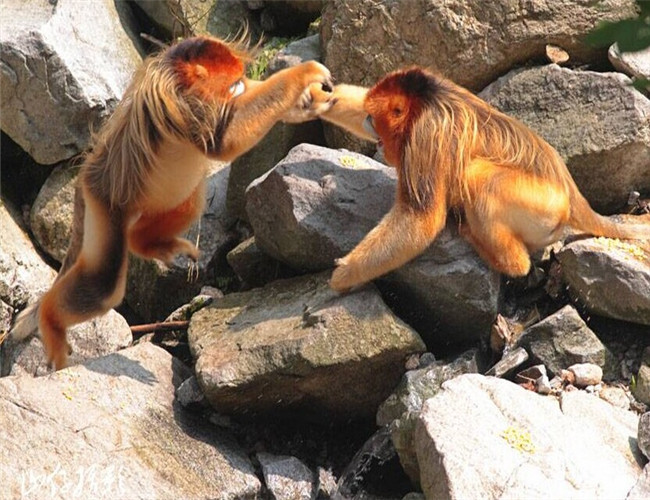
The snub-nosed monkey (Rhinopithecus) is relatively rare in number, and as the saying goes, scarcity makes things precious, so it has become a rare and endemic animal of China. Because the earliest discovered snub-nosed monkey was the Sichuan golden snub-nosed monkey living in Sichuan, Shaanxi, and Gansu of China, animals of this genus are generally called golden snub-nosed monkeys, and its English name translates literally as ‘snub-nosed monkey.’
Chinese Name: Golden Snub-nosed Monkey
English Name: Rhinopithecus
Kingdom: Animalia
Phylum: Chordata
Subphylum: Vertebrata
Class: Mammalia
Subclass: Theria
Order: Primates
Suborder: Anthropoidea
Family: Cercopithecidae
Subfamily: Cercopithecinae
Genus: Rhinopithecus
Species: Sichuan, Yunnan, Guizhou, and Vietnam snub-nosed monkeys
Distribution: Yunnan, Guizhou, and Sichuan in China; Cambodia
2 Physical Characteristics of the Rhinopithecus
There are currently six species of snub-nosed monkey: the Myanmar, Nujiang, Sichuan, Yunnan, Guizhou, and Vietnam snub-nosed monkeys. Among them, the Myanmar and Vietnam species are endemic to China. So what distinguishes these types?
Shared features of snub-nosed monkeys are large, upturned nostrils, thick lips, and no cheek pouches, evolved to adapt to high-altitude hypoxia.
The Sichuan snub-nosed monkey has golden-yellow fur, long hair on the shoulders and back, and a tail as long as or longer than the body; adult males average 680 mm in body length and 685 mm in tail length.
The Guizhou snub-nosed monkey is similar to but slightly smaller than the Sichuan type, with a longer tail; body length 637 to 690 mm, tail 846 to 905 mm, back gray-brown sometimes with a yellowish tone.
The Yunnan snub-nosed monkey is somewhat larger than the Sichuan type, body length 740 to 830 mm, with a relatively short tail nearly equal to the body at about 510 to 720 mm; the back, sides, outer limbs, hands, feet, and tail are all gray-black, with sparse gray-white long hair on the back. The neck sides, belly, rump, and inner limbs are white.
The Nujiang snub-nosed monkey is entirely black except for some white on the face, chest, and perineum; weight is generally 20 to 30 kg, larger ones 35 to 45 kg, body length about 1.2 m.
The Vietnam snub-nosed monkey is smaller, with black chest and abdomen and pale yellow inner limbs.
The Myanmar snub-nosed monkey is almost entirely black, with a tuft of long fine forward-curling black hair on the crown, small white tufts on the ears and cheeks, pale pink facial skin, a distinctive white beard on the chin, and a clearly distinguishable white perineum; the tail is long, nearly 1.4 times the body length, adult males are 55.5 cm long with a 78 cm tail.
3 Rhinopithecus Habitat
Although snub-nosed monkeys are intelligent and diverse, they are nationally protected animals, so private keeping is illegal, and they have high husbandry requirements, making them difficult for beginners.
The snub-nosed monkey is a typical forest, arboreal animal, living year-round in forests at 1,500 to 3,300 m elevation. Its vegetation types and vertical distribution bands belong to four types: subtropical montane evergreen and deciduous broad-leaved mixed forest, subtropical deciduous broad-leaved forest, evergreen coniferous forest, and secondary conifer-broadleaf mixed forest. With the seasons they do not migrate horizontally but move vertically within their habitat. They live in groups; each large troop is organized into family-based subunits. The largest groups can exceed 600 individuals, a remarkably large troop size among primates.
4 Rhinopithecus Care Tips
Snub-nosed monkeys like to live in groups and get along peacefully with companions; their lifestyle is very similar to humans. In a monkey family, the juveniles are very curious and playful and are doted on by the parents. However, once a young male matures, he is driven out by his father and must live independently in the wild. They inhabit high mountain dense forests, living mainly in trees but also foraging on the ground. They eat wild fruits, buds, bamboo shoots, and moss; staples are leaves, tender twigs, flowers, and fruit, plus bark and roots, and they like insects, birds, and bird eggs.