Physignathus lesueuri
2 Photo Gallery
View All 9 Photos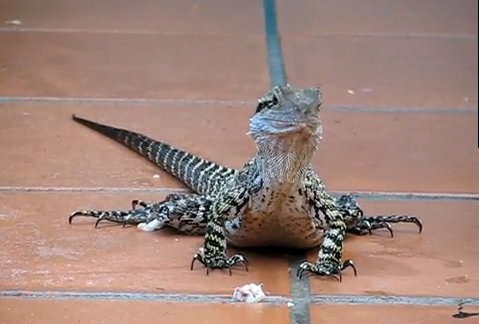


1 Overview
The Australian Water Dragon is very gentle in temperament; with proper care it grows up healthy. Its medium size makes it an ideal choice for those who like gentle, swimming lizards, and the Australian Water Dragon is a good option. It is docile and does not bite. Its appearance is very similar to the Green Iguana; the two can be distinguished by the fact that the Green Iguana has large rounded scales on its cheeks, while the Australian Water Dragon does not. When choosing one to buy, check that the limbs, tail, and snout are intact, the eyes are bright, the body weight is not too low, and the activity level is high. Specimens on the market are usually wild-caught from their native range rather than captive-bred, so large adults tend to be more wild; unless you are sure it has been raised by hand from a young age, purchase is not recommended.
Chinese name: Australian Water Dragon
Scientific name: Physignathus lesueuri
Family: Agamidae
Genus: Physignathus
Diet: Feeds on insects, frogs, and other small animals, as well as fruit
Distribution: Coastal regions of eastern Australia.
Reproduction: Oviparous (egg-laying).
2 Physical Characteristics
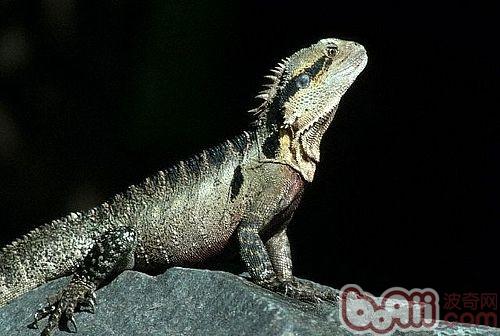
The Australian Water Dragon reaches a total length of 70 cm; its nuchal crest is shorter than that of the Green Water Dragon, but remains well developed in males, forming a cockscomb shape. It has a gular pouch. Behind the eye there is a black banded stripe, and dark banded markings run from the body to the tail. The area below the throat to the belly is mostly orange-red. It inhabits woodland along rivers and is diurnal. Lifespan is 10-20 years, and with correct nutrition and husbandry can reach 25 years. The Australian Water Dragon typically feeds on insects, frogs, and other small animals or fruit. Adults are deep to light green with a white or pale-yellow belly. Males have a larger, broader head and a longer dorsal crest. The water dragon is docile and does not bite.
The water dragon’s appearance is very similar to the Green Iguana; they are distinguished by the Green Iguana’s large rounded cheek scales, which the water dragon lacks. When choosing one to buy, check that the limbs, tail, and snout are intact, the eyes are bright, the body weight is not too low, and the activity level is high. When temperatures are insufficient, the Australian Water Dragon reduces its activity; prolonged low temperatures cause digestive problems and other illnesses.
3 Care Guidelines
The Australian Water Dragon is an arboreal, semi-aquatic lizard, so its enclosure must provide climbing branches and a large enough water basin for soaking and swimming. The substrate is best covered with bark, crushed coconut shell, wood shavings, and dry leaves. Because these lizards are fast-moving, energetic, and somewhat nervous, a spacious enclosure is best; otherwise the snout often gets scraped against the walls, leading to skin damage and even infection. Generally, the enclosure length should be at least twice the dragon’s total length, accounting for full adult size. The enclosure also needs adequate height. A wooden terrarium of at least 100x60x100 cm is recommended, with minimal glass surfaces, because the dragon does not register glass and will frequently jump and hit it.
The Australian Water Dragon is distributed along the coastal regions of eastern Australia, in warm, humid tropical forests. Specimens on the market are usually wild-caught from their native range rather than captive-bred, so large adults tend to be more wild; unless you are sure it has been hand-raised from a young age, purchase is not recommended.
4 Care Guidelines
The Australian Water Dragon does well at a daytime temperature of 28-31 deg C, with a basking spot up to 33 deg C; nighttime 20-25 deg C (use a daylight heat lamp by day, and a night heat lamp, infrared heater, or ceramic heater at night). When temperatures are insufficient it reduces activity; prolonged low temperatures cause digestive problems and other illnesses. The Australian Water Dragon needs fairly high humidity, about 60-90%, usually maintained at 70-80%. Mist the dragon and the enclosure once or twice daily to keep humidity up. Dry air harms their health, causing dry skin and even dark, shed-off spiny scales. Like other diurnal lizards, it needs sunlight to produce vitamin D3, aiding calcium absorption and bone formation. Provide 12-14 hours of direct sunlight daily; when natural sunlight is unavailable, artificial UVB lighting is essential. In cooler seasons, provide a basking bulb (e.g., a sun lamp) to raise body temperature and support digestion and normal metabolism.
The Australian Water Dragon is an arboreal, semi-aquatic lizard, so its enclosure must provide climbing branches and a large enough water basin for soaking and swimming. The substrate is best covered with bark, crushed coconut shell, wood shavings, and dry leaves. Because these lizards are fast-moving, energetic, and somewhat nervous, a spacious enclosure is best; otherwise the snout often gets scraped against the walls, leading to skin damage and even infection. Generally, the enclosure length should be at least twice the dragon’s total length. The enclosure also needs adequate height. A wooden terrarium of at least 100x60x100 cm is recommended, with minimal glass, because the dragon does not register glass and will frequently jump and hit it.
5 Feeding Requirements
The Australian Water Dragon is very gentle; with proper care it grows up healthy, and its medium size makes it an ideal choice for those who like gentle, swimming lizards. It is a predominantly carnivorous omnivore. Young dragons can be fed mealworms, crickets, grasshoppers, earthworms, and snails dusted with calcium and vitamin powder. Adults can be fed mice, sparrows, small fish, or small pieces of pork or beef, along with a little chopped leafy greens and vegetables. The enclosure must also provide a large water basin for soaking and swimming, with substrate of bark, crushed coconut shell, wood shavings, and dry leaves. Because these lizards are fast, energetic, and somewhat nervous, a spacious enclosure is best to avoid snout abrasions that can lead to infection.
The Australian Water Dragon needs sunlight to produce vitamin D3, aiding calcium absorption and bone formation. Provide 12-14 hours of direct sunlight daily; when natural sunlight is unavailable, artificial UVB lighting is essential. In cooler seasons, provide a basking bulb (e.g., a sun lamp) to raise body temperature and support digestion and normal metabolism.