Pancake Tortoise
2 Photo Gallery

1 Overview
The pancake tortoise (Malacochersus tornieri) lives in rock crevices at ~1,800 m, 24-30 C, often one male-one female but sometimes up to ten per crevice. Males may move between crevices; females tend to stay. Its flat, flexible shell lets it wedge into gaps thinner than itself – making it the fastest tortoise and very hard to extract.
CONSERVATION NOTE: listed CITES Appendix II / IUCN threatened; Kenya banned export in 1981 (except with ministerial permit) and Tanzania protects it in the Serengeti. Trade is restricted.
2 Appearance
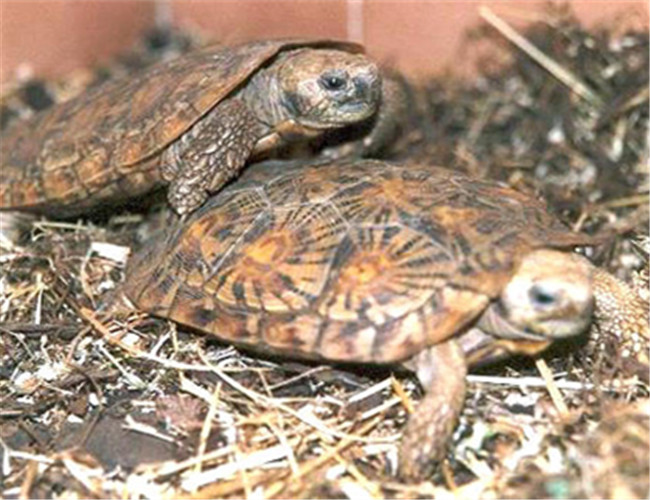
Unusual: not domed but flat, with vivid patterns like a squashed star tortoise, and small (plastron 12-15 cm, ~500 g). The plastron has large smooth soft areas and grooves on the bony scutes; the shell is quite flat with some concavity. Adult males have longer, thicker tails (but tail length alone is unreliable for sexing). Its soft, elastic shell squeezes into rock gaps; when threatened it flees rather than retracts.
3 Care & Temperament
Listed on CITES II and IUCN; Kenya and Tanzania restrict its export. It is an escape artist – the enclosure must have inward-turned rims or a mesh lid, and keep same-sized individuals, ideally one male with several females.
4 Habitat & Environment
Native to the Kopjes rock outcrops of Tanzania and Kenya, whose natural fissures and climbing surfaces shaped its coordinated limbs. The radiating carapace pattern is camouflage; when scared it darts into a crevice and wedges with splayed front feet. Captive: dry substrate (newspaper or clean soil, mixed with playground sand), rock slabs/branches for climbing, and a 100 W ceramic heater over a warm slab. Keep food off the substrate to avoid gut issues; avoid moisture-holding substrates like hay.
5 Diet & Feeding
Fully herbivorous – feed abundant varied high-fibre grasses (timothy, Bermuda), dandelion, alfalfa, romaine and other dark greens, grape leaf, mulberry, plantain, chicory, opuntia and flowers; always provide calcium (cuttlebone or powder, D3-form indoors). Avoid market lettuce (low fibre, pesticide, sugar) and any animal protein (causes kidney failure/stones). Fruit at most monthly.