Mud Turtle
2 Photo Gallery
View All 10 Photos


1 Overview
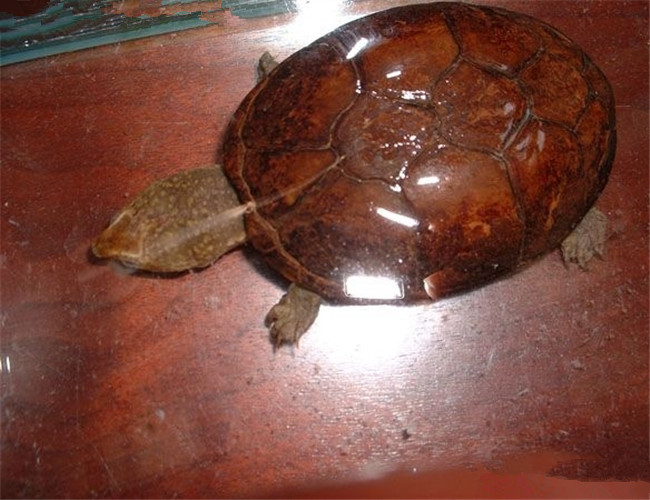
The Mud Turtle is not the name of a single species but of a group of turtles sharing common traits, whether in body structure or distribution, and thus classified under one family.
The Mud Turtle family has two subfamilies, Kinosterninae (mud turtles) and Staurotypinae (musk turtles). The main difference is that the musk turtle subfamily has an internal plate (intergular), while the mud turtle subfamily lacks it, not useful for live identification. They inhabit freshwater muddy environments; some species climb well and are carnivorous. The musk turtle genus Sternotherus is common in the pet turtle market, called the egg turtle.
Chinese Name: Mud Turtle
Scientific Name: Kinosternidae
Kingdom: Animalia
Phylum: Chordata
Subphylum: Vertebrata
Class: Reptilia
Subclass: Anapsida
Order: Testudines
Family: Kinosternidae
Genus: Kinosternon
2 Physical Characteristics
The Kinosternon genus is a large group, similar in appearance and usually hard to identify; in the wild, hybridization can occur, adding difficulty. Below are the common turtles within the genus and their differences.
The musk turtle genus Sternotherus has four accepted species. The razor-backed musk turtle, also called the razorback or roof turtle, indeed has a very steeply sloped carapace, triangular from the front; unlike other Sternotherus and Kinosternon, its plastron has only ten plates. The flattened musk turtle, also aptly named, has a very flat and broad carapace; once considered a subspecies of S. minor. The loggerhead musk turtle’s carapace shape lies between S. depressus and S. carinatus. Like others, S. minor has a weak hinge between the pectoral and abdominal shields. S. minor peltifer has distinct neck stripes, differing from the loggerhead musk turtle. The best-known musk turtle, S. odoratus, the common musk turtle, has a small plastron and two distinctive stripes from the jaw back past the eyes on each cheek.
The Kinosternon genus has five species found in the U.S. K. baurii, the striped mud turtle, is perhaps the most recognizable, small even among mud turtles, with three longitudinal pale stripes on the carapace. Like all mud turtles, its plastron has two strong hinges. Overlapping in range is the Mississippi mud turtle, K. subrubrum, also small but without carapace stripes; it is rather featureless, occasionally with some markings, usually yellow head spots or faint stripes, more common in K. s. hippocrepis. This subspecies is sometimes confused with K. baurii; apart from the back stripes they are very similar. Further west is the yellow mud turtle, with a plain olive or brown carapace and yellow, gray-edged skin. Two others recently entered the U.S.: K. hirtipes and K. sonoriense. The Sonora mud turtle is medium-sized, somewhat elongate, with olive to brown carapace and gray skin dotted with black. The Mexican mud turtle has one subspecies in the U.S., in Texas; its carapace has three keels and black skin, with a beautiful net-like head pattern.
3 Care & Husbandry
The Kinosternon genus is large and complex, so generalizations are hard, but these turtles share traits; below are the care focuses based on their characteristics.
Generally, mud turtles and musk turtles are easily held in hand. Newly caught or very stressed turtles release a yellowish substance from glands at the shell edge; this pungent fluid gives them their common name. Captive individuals soon lose this habit. Even hatchlings produce the odor when disturbed. Some large Kinosternidae species bite hard, so handle carefully. The two Sternotherus species are known for biting, but apart from fierce temper, they live long in captivity. For these reasons, handle them as little as possible.
Species from the northern edge of the family’s range hibernate each year. Those in hot, dry areas aestivate in the hottest period, especially when water dries. Though mainly aquatic, some species spend much time out of water; e.g., S. carinatus is active in afternoons and often found basking. K. subrubrum and K. baurii are also often found on land.
In temperament, many musk turtles are shy and unsociable; S. triporcatus and S. salvinii are exceptions. C. angustatus is known to bite when held. Other newly caught species may bite; Pritchard reported a severe bite from a Florida mud turtle.
4 Habitat & Environment
The Mud Turtle’s environment is complex: some like deep water, some shallow; some need high heat, some low temperature for hibernation, so no single rule; set up per species.
Depending on species and conditions, they can be kept outdoors year-round or part-year. Outdoor animals need both land and water; fence the area to prevent escape. Because mud and musk turtles are occasionally preyed on by large birds and raccoons that climb, full covering is needed to prevent loss. Outdoor setups offer a more natural environment but hinder close observation for disease signs.
Tank setup can be simple or elaborate, depending on the species’ natural needs and the keeper’s goals. If observing natural behavior is a goal, mimic the native environment as closely as possible. The simplest build also suffices for basic keeping. By species, the tank bottom can be sand, gravel, mud, or bare. Place rock piles, driftwood, or floating cork.
Lighting depends on the mud or musk turtle type. Many are nocturnal or active in dim light, do not bask, so avoid frequent use of daylight lamps; likewise full-spectrum bulbs are unnecessary. However, if plants are grown in the system, full-spectrum light benefits them and does not harm the turtle. Turtles still need normal day-night cycles, so provide light-dark alternation like the outdoors or matched to the native photoperiod. Seasonal day-length changes should follow the species.
5 Diet & Nutrition
Mud turtles’ food choice is complex; do not generalize by species. What they like best depends on the species, and some are aggressive and cannot be mixed with other turtles.
Mud turtles are conditional omnivores or carnivores. They eat various foods, whatever is available locally. Captive mud turtles eat most foods they ate in the wild, such as insects, earthworms, and fish, easily accepted.
For omnivorous species, vegetables should be a regular staple. Commercial turtle diets are accepted by most mud turtles but need an adjustment period. Do not let them develop picky habits; include varied edible foods. Regularly add vitamins and calcium to prevent unnoticed calcium deficiency and vitamin shortage causing malnutrition. One keeper’s turtles loved calcium blocks made of loess mixed with vitamins and calcium powder, which also help exercise the jaw. Final warning: some aggressive species may bite each other when feeding in captivity, sometimes causing limb loss.