Mississippi Diamondback Terrapin
2 Photo Gallery
View All 9 Photos


1 Overview
The Mississippi Diamondback Terrapin is distributed in the United States and is a semi-aquatic turtle. Wild numbers are not large and it is fairly difficult to keep, so captive numbers are also small and it is hard to find on the market. It requires higher temperatures and can hibernate in cold conditions.
Chinese name: Diamondback Terrapin
Binomial name: Malaclemys terrapin pileata
English name: Mississippi Diamondback Terrapin
Kingdom: Animalia
Phylum: Chordata
Subphylum: Vertebrata
Class: Reptilia
Order: Testudines
Suborder: Cryptodira
Family: Emydidae
Genus: Malaclemys
Species: Mississippi Diamondback Terrapin
Diet: Feeds on crustaceans.
Distribution: United States, from the Florida panhandle to eastern Louisiana.
Physical features: Maximum carapace length 24 cm; low carapace with concentric growth rings and grooves on the vertebral and costal scutes. The head is pale with dark spots.
Classification: Divided into 7 subspecies, which differ in color and appearance even among themselves. Common ones are the Texas Diamondback, Ornate Diamondback, and Northern Diamondback.
Habitat: Inhabits marshes near the sea and at the interface of rivers and sea.
Reproduction: Eggs laid from April to July; the number and size of eggs vary by locality.
2 Physical Characteristics
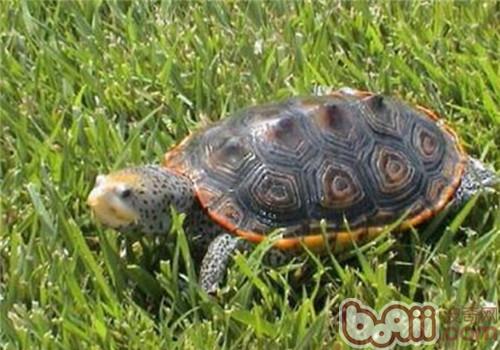
The Mississippi Diamondback Terrapin has a darker carapace than other varieties; the head and limbs are white with black spots. The diamond markings are indistinct, with an orange or yellow center, making it relatively easy to recognize, and it is of medium size.
The Mississippi Diamondback Terrapin is one of the rarer varieties and closely resembles the Texas Diamondback. Each concentric ring on the carapace is pale in the center and surrounded by darker tones, with the outer shell bordered by a ring of yellow or orange. The three tubercles are a striking “anti-counterfeit mark.” The skin is paler, and the diamond markings on the head vary in color and size, forming scattered rather than dense spots.
The center of the concentric rings on the Mississippi Diamondback Terrapin’s carapace is pale or orange-yellow with concentric banding, a high keel, small tubercles, and a yellow-orange outer border; the carapace is brightly colored. The skin of the head and neck is densely spotted and white. Females are larger, usually 15 to 23 cm in carapace length, with a blunter head and a short thin tail; males are smaller, usually only 10 to 14 cm, with a sharper head and a long thick tail.
3 Care Guidelines
The Mississippi Diamondback Terrapin is relatively scarce and fairly difficult to keep. Its distribution is limited, with traces found only in a small range. Wild-caught terrapins are exported to various countries and are occasionally seen in our pet market.
I. Care notes for the Diamondback Terrapin
The Diamondback Terrapin is the only North American turtle that can live in brackish water, so its populations are not small. Each has different color variations. Even within a subspecies, colors can differ greatly, making identification difficult. But the one shared feature, the diamond pattern, is present in all seven subspecies. They are carnivorous, feeding entirely on fish, shrimp, and shellfish. They especially love crustaceans such as crabs, clams, and barnacles, so they have hard jaw plates to crush shells. A little coarse salt should be added to the water; otherwise they easily develop skin rot, which is contagious, and affected individuals must be isolated promptly. Applying penicillin powder directly to the affected area has some effect.
II. Keeping the Mississippi Diamondback Terrapin
Compared with wild individuals, Mississippi Diamondback Terrapins are generally healthier and accept captive conditions more readily. They live in salty water, ranging from coastal marshes to islands surrounded by natural seawater. In the wild their food includes clams, shrimp, crabs, snails, and small fish. They occasionally eat a little plant matter but are mainly carnivorous.
4 Behavior & Habitat
The Mississippi Diamondback Terrapin has high environmental requirements. Whether water quality, temperature, or lighting, everything must be just right. Juveniles and adults have little difference in their needs, as outlined below.
I. Environment for juvenile Mississippi Diamondback Terrapins
A Mississippi Diamondback Terrapin hatchling can be kept in a nearly full 10-gallon tank (about 50 x 28 x 33 cm). They need a basking platform and a heat source. Use a reflective clip lamp in one corner of the tank to create a basking spot, positioned to warm the platform to about 32 degrees Celsius. The enclosure should also have a full-spectrum fluorescent tube providing UVB.
It is recommended to add real or plastic aquatic plants to give the turtle a sense of security and a place to hide. Filtration is very important for hatchlings; if the water is not kept clean, the small turtle easily develops skin problems. Water temperature should be kept around 25 degrees Celsius.
II. Environment for adult Mississippi Diamondback Terrapins
An adult male needs a tank of at least 75 gallons (about 122 x 48 x 56 cm), and a female at least 100 gallons (about 185 x 48 x 51 cm). A 100-gallon horse-watering tank works well, providing 60 cm of water depth and a large surface area for swimming.
Avoid large rocks in the tank, as they can crack and chip the shell, making the turtle vulnerable to shell rot and other fungal infections. An outdoor enclosure that protects against predators has many advantages over an indoor one and should be seriously considered in warm weather. Hiding a child’s wading pool in a secure area makes an easy-to-maintain outdoor setup.
5 Feeding Requirements
The Mississippi Diamondback Terrapin is not demanding about food; the usual foods for aquatic turtles apply, such as freeze-dried shrimp, and it also enjoys soft-bodied animals and shellfish.
I. Food selection for the Mississippi Diamondback Terrapin
The Mississippi Diamondback Terrapin is a carnivorous turtle that mainly eats fish and shrimp and loves crustaceans. Keep the diet varied: mainly small fish, supplemented with small live shrimp, and occasionally reward with canned dried shrimp or fresh clams. Some overseas sites show keepers using koi food as a staple with healthy growth.
II. Feeding precautions for the Mississippi Diamondback Terrapin
Do not feed inside the enclosure, because this pollutes the water and the turtle easily gets sick. Always feed in a separate container with clean fresh water, a dedicated dining area. Also avoid feeding when the temperature difference is too large; if the environmental temperature changes by more than 15 degrees in a short time for any reason, do not feed that day, wait until it returns to normal and feed the next day. Finally, when first starting to eat, feed little; after any stop in feeding, whether after hibernation, a new arrival, or recovery from illness, start with small amounts and gradually return to normal portions once everything looks fine.