Malayan Snail-eating Turtle
2 Photo Gallery
View All 9 Photos


1 Overview
The Malayan snail-eating turtle likes to eat snails, freshwater snails, and similar foods, which is why it is called the snail-eating turtle; it is also sometimes simply called the Malayan turtle. Distributed across Malaysia and surrounding regions, it is of moderate size but not suited to home keeping.
The snail-eating turtle generally inhabits slow-moving streams or swamps, feeding mainly on aquatic snails, freshwater mollusks, and clams, and occasionally preying on aquatic insects or shrimp and crabs. This specialized diet makes it hard to adapt to long-term captive keeping unless shelled foods are regularly provided. It is naturally rather timid, so avoid disturbing it during the initial acclimation period.
Chinese name: Malayan snail-eating turtle
Latin name: Malayemys subtrijuga
English name: Malayan Snail-Eating Turtle
Also known as: Malayan turtle, snail turtle, snail-eating turtle
Kingdom: Animalia
Phylum: Chordata
Class: Reptilia
Order: Testudines
Family: Testudinidae
Genus: Malayemys
Species: Malayemys subtrijuga
Geographic distribution: Vietnam, Cambodia, Thailand, Malaysia
Habits: Lives in streams, swamps, and paddies. Suitable temperature: 24–28°C
Size: Moderate; carapace length up to 21 cm
Reproduction: Sexing is not difficult — males are smaller with thicker tails. Females lay 3–6 eggs per clutch, hatching in about 70–90 days at 29°C.
Diet: Enjoys snails, small fish, earthworms, worms, and crustaceans
Notes: Cannot hibernate; requires heated keeping in winter
2 Physical Characteristics
The Malayan snail-eating turtle is not large, usually about the size of a Chinese pond turtle as an adult, but it is thoroughly carnivorous, specializing in soft-bodied mollusks, so it is not easy to keep — in some seasons the right food is simply unavailable.
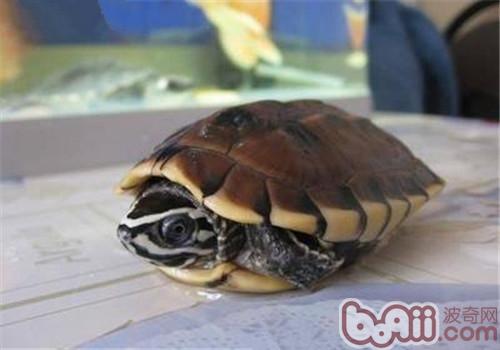
The Malayan snail-eating turtle is a very slow-growing turtle. The head is relatively broad and large, black on top, with a ‘V’-shaped white stripe along the edge that passes above the eye and extends onto the neck, gradually thickening; the snout is blunt, and the eye is surrounded by a white eye-line like wearing spectacles. At the nostrils there are four white longitudinal stripes; from the front of the eye socket a yellow-white spot appears, with a yellow-white diagonal stripe below it that passes under the eye and extends onto the neck, thickening gradually. The center of the upper jaw forms an ‘A’ shape, and the center of the lower jaw has two thick white stripes extending onto the neck; the neck is black with several longitudinal stripes of varying thickness.
The carapace is black with three fairly distinct central keels; the marginal scutes are yellow-edged (clearly so in juveniles), and there are black blotches at the bridge. The plastron is yellow with a large black blotch on each scute, and the mid-posterior rear edge has a deep notch. The limbs are black with yellow-white longitudinal stripes along the edges, and the toes are webbed. Both sexes have a flat plastron without a concavity. To sex them, look at the tail: a turtle with a thick, long tail is male, otherwise female.
3 Care & Maintenance
The Malayan snail-eating turtle is very timid and has difficulty adapting in the early keeping period, so avoid unnecessary disturbance. If there are children at home, place the turtle where they cannot reach it, and gradually encourage it to start feeding.
1. Key Care Points for the Malayan Snail-eating Turtle
The Malayan snail-eating turtle likes warmth and fears cold; it should not be purchased in late autumn, early spring, or winter, when survival rates are low. Newly bought turtles should not be placed in deep water at first; keep them in shallow water, disturb them little, and let them gradually adapt. For more active ones, try offering earthworms, yellow mealworms, or snails. This turtle has weak adaptability, so daily care must strictly monitor temperature changes: at 18°C it stops eating, at 15°C it becomes inactive and drifts toward hibernation, and when the temperature fluctuates by about 4°C it shows restlessness, head-extending, or head-retracting. Winter temperatures must not stay below 10°C for long, or the turtle is prone to rectal blockage and similar ailments, which can be fatal in severe cases.
2. Conservation of the Malayan Snail-eating Turtle
The snail-eating turtle is the single species of the genus Malayemys, a diurnal, aquatic turtle. Its coloration is among the more striking of the small-to-medium water turtles, and it has a specialized diet. It has powerful jaws that easily crush freshwater crustaceans before swallowing. It is a common terrapin in Vietnam and Thailand; because of its abundance, despite its small size it is heavily exported for food and the pet trade. At the end-of-year CITES conference the snail-eating turtle is expected to be listed under CITES Appendix II, so the number available in the market will greatly decrease in future.
4 Natural Habitat
The environment greatly affects the Malayan snail-eating turtle’s health, especially temperature changes, which directly impact its internal digestive function. Note that this turtle does not hibernate; forcing it to hibernate will only lead to death.
1. The Malayan Snail-eating Turtle and Environmental Temperature
The Malayan snail-eating turtle has weak adaptability, so daily care must strictly monitor temperature changes: at 18°C it stops eating, at 15°C it becomes inactive and drifts toward hibernation, and when the temperature fluctuates by about 4°C it shows restlessness, head-extending, or head-retracting. Winter temperatures must not stay below 10°C for long, or the turtle is prone to rectal blockage and similar ailments, which can be fatal in severe cases.
2. Enclosure Setup for the Malayan Snail-eating Turtle
The Malayan snail-eating turtle is of moderate size, with a carapace up to 21 cm long. Based on the turtle’s size, buy a plastic bin or glass tank 7–12 times the turtle’s body size, with a height over twice the carapace length to prevent escape. Lay down artificial turf and press a few pebbles on it. Water depth should be about 1–2 cm — do not submerge the whole body, only partly; long-term full submersion easily causes shell and claw rot and death. Change the water every two days.
5 Care Guidelines
The Malayan snail-eating turtle is not omnivorous, nor does it eat strange meats; it eats only mollusks, and its favorite is snail meat, so it is recommended to buy the freshest snail meat for feeding.
Because it eats only snail meat, you can buy apple snails or field snails at the market — they must be alive, as the turtle will not eat dead ones. Use scissors to crack the shell and remove the meat, then smell it to confirm there is no foul odor. Prepare a basin with water deep enough to cover the turtle, about 10 cm. Place the turtle and the snail meat in together, adding one snail at a time (too much meat releases excess scent that prevents the turtle from locating the food). Step away and do not watch; it usually starts feeding within 3 days, and if it has not by then it likely never will.
Because its diet is so narrow, the Malayan snail-eating turtle is prone to septicemia. You can mix children’s multivitamin tablets with children’s calcium tablets containing vitamin D3, grind them into powder with a household grinder, and add about 5 g per feeding. Alternatively, add half a children’s multivitamin tablet plus two vitamin-D3 calcium tablets.