Indian Star Tortoise
2 Photo Gallery

1 Overview
The Indian star tortoise (Geochelone elegans) is a striking, star-patterned tortoise. It is not ‘hard’ because it gets sick often – rather it is infamous for sudden death: illness can be treated, but sudden collapse cannot.
CONSERVATION NOTE: listed CITES Appendix I since 2019 – only captive-bred, documented animals should be kept or traded.
2 Appearance
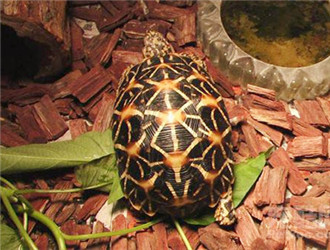
Each carapace scute carries radiating star lines (8+ per scute in adults, fewer in hatchlings); the plastron shows the same pattern. It is the smallest of the tortoise family (30-38 cm). The star pattern is camouflage in dry grass. Males are smaller and narrower with a concave plastron and thick tail; females are broader with a flat plastron and short tail.
3 Care & Temperament
Success starts with a robust juvenile (choose ~8 cm over 3-4 cm ‘ping-pong stars’), bright eyes and good weight. Keep temperatures above 25 C with small day-night swings (~28 C). They tolerate dry air but sudden humidity changes kill them. Give UVB but also real sunbathing with shade.
4 Habitat & Environment
They are very sensitive to temperature and humidity – bad control causes pneumonia or stones. Base temperature 28 C+, with a 35-38 C basking spot and a belly heating pad (cold bottoms stall digestion). Any glass/plastic tub works if managed; separate sexes before breeding.
5 Diet & Feeding
Strictly herbivorous and sensitive to watery food (diarrhoea). Feed varied weeds and leaves – the staple should be dry, high-fibre greens (dandelion, radish/rape leaves, mulberry, alfalfa, sunflower sprouts). Avoid spicy/irritating foods; offer ‘constant’ hardy greens between main feeds.