Hydromedusa maximiliani (Brazilian Snake-necked Turtle)
2 Photo Gallery
View All 7 Photos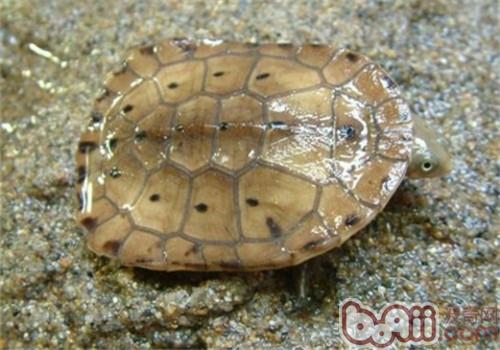


1 Overview
The Brazilian snake-necked turtle, also called the Brazilian fishing turtle, is a freshwater turtle of the genus Hydromedusa in the family Chelidae, mainly living in eastern and southeastern Brazil. It is the smallest Brazilian freshwater turtle, no more than 20 cm (7.9 inches), preferring fast, cold streams with sandy and rocky bottoms.
The Brazilian snake-necked turtle is uncommon on the market and expensive; a small Brazilian fishing turtle can cost over ten thousand yuan, so few keep it. Its appearance is distinctive; juveniles differ greatly from adults, especially in the carapace, and like the red-eared slider, juveniles are prettier and more characteristic.
Scientific name: Hydromedusa maximiliani
Local name: Cágado da Serra
Reproduction: Oviparous
Distribution: The Brazilian fishing turtle is mainly distributed in Bahia, Minas Gerais, Espírito Santo, Rio de Janeiro, and São Paulo in eastern and southeastern Brazil. Its distribution is closely tied to the Atlantic montane rainforest, generally living only above 600 m (2,000 ft) altitude.
In 1825, Mikan first described this turtle under the scientific name Emys maximiliani, then in 1830 Wagler placed it in the genus Hydromedusa (the genus now has two turtles, one the Brazilian fishing turtle and the other the Argentine fishing turtle); later some further descriptions were made, but all were relegated to synonyms of this species. There are no recognizable subspecies within this species.
2 Physical Characteristics
The snake-necked turtle is an ancient family of turtles with a round or heart-shaped shell. The shell is thick, without an entoplastron, with an intergular or inframarginal scute. It lived from the Late Jurassic to the Early Cretaceous. Mainly distributed in Europe and Asia; the genera Hydromedusa and Tianfuchelys found in Sichuan, China, belong to this group.
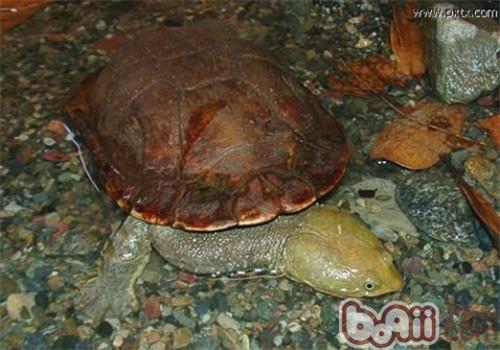
The Brazilian snake-necked turtle’s shell has a strong keel, with black or yellow spots near the head. Females are larger than males. Males have a concave center of the plastron, a deeper anal notch, a long tail, and the cloaca far from the carapace; females have a flat plastron. Eggs are long-elliptical, usually 34 mm long and 20 mm wide.
Most turtles have a very small nuchal scute between the first and second marginal scutes, but the snake-necked turtle is different: its nuchal scute is larger, located behind the first and second marginal scutes and in front of the first vertebral scute. Its head and neck have bright colors and varied stripes.
This type of turtle, unlike most other turtles, cannot retract its head and neck fully into the shell; instead, when the head retracts into the shell, the neck bends to one side, hence the name (the snake-necked turtles of the Chelidae also have this habit). This genus has only one species. The body is gray, up to 30 cm long.
3 Care & Husbandry
Newly caught turtles secrete a strong musk-like smelling liquid as a defense, but this disappears once they are settled in. Even a wild-caught one will take food from your hand after a week, and then swim constantly in front of the aquarium when you enter the room, and surface when you approach. Like many freshwater turtles, they look comical and give their owner great pleasure. This turtle is especially suited to beginners and turtle enthusiasts.
4 Habitat & Environment
The snake-necked turtle can be kept in a large aquarium with a basking area and lighting. The temperature should be kept at 72–76°F. You may consider using peat moss, extending part of it into the water. There is evidence that if the water pH is kept low, around 6.5, these turtles do well and avoid some common skin problems, and peat moss or peat can lower the pH.
5 Care Guidelines
Brazilian fishing turtle
The Brazilian snake-necked turtle eats both plants and animals. It lives in shallow water and occasionally climbs onto land. During the dry season it burrows into pond mud to aestivate until the rains return. It eats large numbers of mosquito larvae, making it very useful to people.
The snake-necked turtle is a suborder of Testudines, evolved from primitive amphibious turtles. The shell structure is usually complete; the neck can bend sideways and retract into the shell. Aquatic. First appeared in the Jurassic; some still survive today. Living species are distributed only in Africa, South America, and Australia. Side-necked turtles include the Madagascar big-headed side-neck, the helmeted side-neck, the Amazon big-headed side-neck, and many other species.
Among aquatic turtles, the side-necked turtles are a unique group, closer to prehistoric ancestors. Their heads cannot retract into the shell, only bending sideways against the front limbs. Interestingly, although North America has many turtles, it has no side-necked turtles, while Central and South America and Australia have more. This type of turtle, unlike most other turtles, cannot retract its head and neck fully into the shell; instead, when the head retracts into the shell, the neck bends to one side, hence the name (the snake-necked turtles of the Chelidae also have this habit). This genus has only one species. The body is gray, up to 30 cm long.
The Brazilian snake-necked turtle is an IUCN Vulnerable species, and its conservation status outside protected areas is not optimistic. It is also rarely seen on the market and can cost tens of thousands of yuan, so keeping it is not recommended.