Hundred-pace Viper
2 Photo Gallery

1 Overview
The Hundred-pace Viper is a venomous snake that favours hillsides, a typical nocturnal reptile active mostly at night. A famous species across Asia and Southeast Asia, especially revered in Taiwan and South China since antiquity. No subspecies have been confirmed.
Chinese Name: Hundred-pace Viper (sharp-nosed viper)
Aliases: white-banded snake, hundred-pace snake, five-pace snake, plough-head snake, money white-banded snake, hundred-section snake, Qi snake
English Name: Hundred-pace Viper
Binomial: Deinagkistrodon acutus
Kingdom: Animalia
Phylum: Chordata
Class: Reptilia
Order: Squamata
Family: Viperidae
Subfamily: Crotalinae (pit vipers)
Genus: Deinagkistrodon
Distribution: southern Anhui, Chongqing, Jiangxi, northern Zhejiang, northern Fujian, Hunan, Hubei, northern Guangxi, northern Guizhou and northern Guangdong, China.
2 Physical Characteristics
Also called the seven-pace or five-pace snake — folklore claims its bite kills within a few paces, exaggerating the venom’s potency. This is legend, not literal fact.
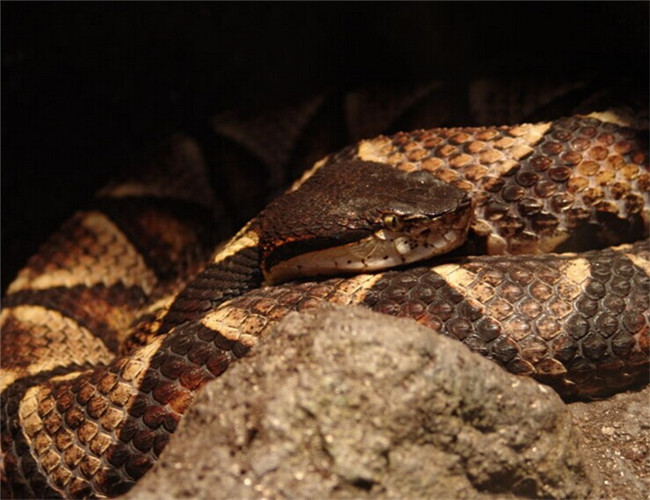
It has a large triangular head with an upturned snout formed by the rostral and nasal scales. The head is dark brown with symmetric large scales and a heat-sensing loreal pit. The body is deep brown; a midline row of 15 to 21 + 2 to 6 large square blotches runs down the back. The belly is white with staggered dark-brown blotches. The body is stocky; the largest male measured 1335 + 206 mm and female 1238 + 165 mm. Dorsal scales are 21(23)–21(23)–17(19) rows, the outer 1 to 3 rows only weakly keeled, the rest strongly keeled and rough; ventral scales 152–169 in males, 162–171 in females; the anal scale is single; subcaudals 51–61 in males, 48–63 in females, mostly paired. The tail tip bears a flattened, long, pointed scale colloquially called the Buddha’s fingernail.
3 Captive Habitat
A deadly venomous snake — a bite is often fatal, so it is not recommended for home keeping and especially not for beginners; the danger is extreme. It likes an environment above 25°C with 60–80% humidity; the breeding season differs from ordinary keeping.
A snake farm should be built on ventilated, sunny, watered land far from residences, with a natural slope, good drainage and wild grass. Walls 1.6 to 2 m high, inner surface smooth with arched corners. The foundation should go 0.5 to 1 m deep and be poured with cement to block rats; the inner wall should be the natural cement colour, not white, to avoid reflective heat raising the temperature. Plant some low, slow-growing shrubs for climbing and shade.
During the breeding season it prefers 19.2–32°C air, 17.5–31°C soil, and 51–94% relative humidity. Egg incubation requires 25–30°C and 51–95% relative humidity.
4 Feeding
It is a broad-feeding snake that refuses almost nothing edible. Its digestive system is undeveloped — it typically starts digesting and excreting only five days after eating, so a week without food is fine. Captive individuals feed quietly without moving much.
It fears high heat; above 28°C or below 8°C it generally stops eating. Feed at midday above 15°C in cold periods and in the evening in hot periods; it is severely light-shy, with a large appetite — eating at least one third of its body weight, reaching over 40% in cool autumn.
Its food includes frogs, toads, lizards, birds and rodents, with rodents most frequent. It is oviparous, lays rarely, and grows slowly — a rare animal. Captive and wild individuals differ little; captive ones are slightly fatter and tamer from better nutrition, while wild ones are darker and slimmer.