Helmeted Turtle
2 Photo Gallery

1 Overview
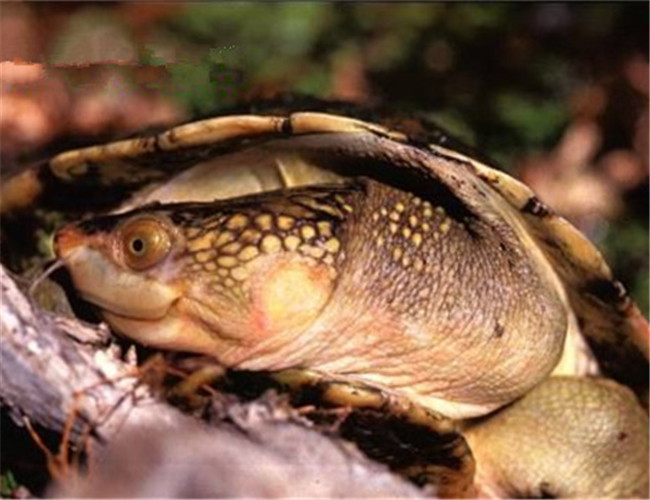
The helmeted turtle (Pelomedusa subrufa), also called the marsh side-neck, is a common African side-neck sold around RMB 200. It likes meat and, in the wild, even catches small birds.
SOURCE NOTE: the source gave the binomial Pelomedusa subrufa, retained here. It is a side-neck (folds the neck sideways, no hinge).
2 Appearance
A small turtle, most under 20 cm (record 32.5 cm). The brown carapace is rectangular and flat-centred with wide dark seams; the dark plastron has no hinge. The head/neck are grey-brown with dark spots, large eyes and a human-like (‘V’) mouth; limbs are brown above, cream below, fully webbed with 5 claws each. When scared it can release a musky scent (fades with taming). Males are smaller with thick tails.
3 Care & Temperament
Once abundant (a 1980s craze) then depleted and briefly endangered, now slowly returning to the pet trade. A water turtle of lakes, rivers and swamps that aestivates in mud during drought – very tolerant of change and gregarious. Carnivorous (insects, small animals); in captivity eats lean pork and small fish. Lays 13-16 eggs in late spring/early summer; eggs arrive coated in hard, waterproof mucus.
4 Habitat & Environment
Adapts well; hobbyists use aquaria, farms use outdoor ponds. A 12 m2 concrete pond, 0.3-0.5 m deep, with a sand-land nesting area (>=1.5x shell length), escape wall and ramp. Disinfect before stocking; dip new turtles in salt/KMnO4. Patrol twice daily, keep water fresh, pull out lethargic turtles.
5 Diet & Feeding
A strong, big-eating carnivore-leaning omnivore that feeds underwater. In rain it eats fish/tadpoles/frogs and aquatic inverts; in drought it takes birds, lizards, snakes, rodents. Grows slowly (4-5 years to adult). Sink the food; feed every 2-3 days at 20-24 C, daily above 25 C, not below 20 C; portion 1-5% body weight, mostly high-protein pellets.