Greater Green Snake
2 Photo Gallery

1 Overview
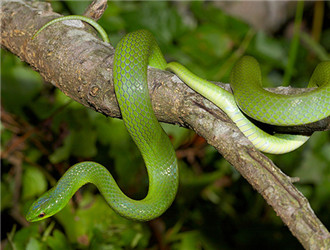
The greater green snake (Cyclophiops major), also the green snake, is a common non-venomous snake, very gentle – almost ‘introverted’ – it avoids people, neither attacking nor biting. In summer wild ones rest motionless on trees.
SOURCE NOTE: the source gave the name as ‘EuryPholis major’; the accepted binomial is Cyclophiops major. It is listed under China’s terrestrial-wildlife protection; do not collect wild individuals.
2 Appearance
Often confused with the pit viper Trimeresurus (bamboo green viper); people kill green snakes thinking they are vipers. Differences: the green snake is non-venomous, gentle, generally larger; the pit viper has a distinctly triangular red-eyed head, small scales, short yellow-green tail. The green snake has large black eyes, smooth glossy green body, no pattern, very long tail.
Slender, medium-sized, 80-110 cm. Elliptical slightly pointed head with large scales (vs the viper’s tiny scales). Large black eyes, smooth glossy body in deep green, yellow-green or emerald; underside of head and front body pale yellow-green. Long tail, good at hiding by colour; flees fast when threatened.
3 Habitat & Environment
From southern China’s low-mid hills near mountains; listed under terrestrial-wildlife protection. Non-venomous and gentle, so beloved. Use a dark thick glass or clear plastic or acrylic tank, preferably larger, landscaped with branches, leaves, rocks, water to give security and allow normal feeding.
Fill with 10-15 cm humus-rich soil, plant a few greens or place pots; it is arboreal, so add thick branches or bonsai to climb and sleep on. Keep a food dish of water permanently in the tank.
4 Diet & Feeding
Likes to live near water, so provide drinking water for humidity and drinking. Eats earthworms, tree frogs, rain frogs – mainly earthworms, but only grey (not red) ones. Also small frogs. Mainly insects: spiders, moths, butterflies, grasshoppers. Oviparous; feed hatchlings every other day, adults weekly. It brumates in winter and will not eat.