Cricket
2 Photo Gallery
1 Cricket Breed Overview
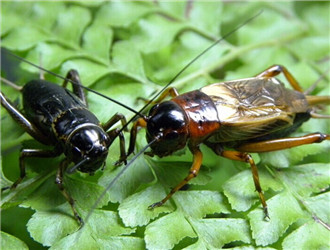
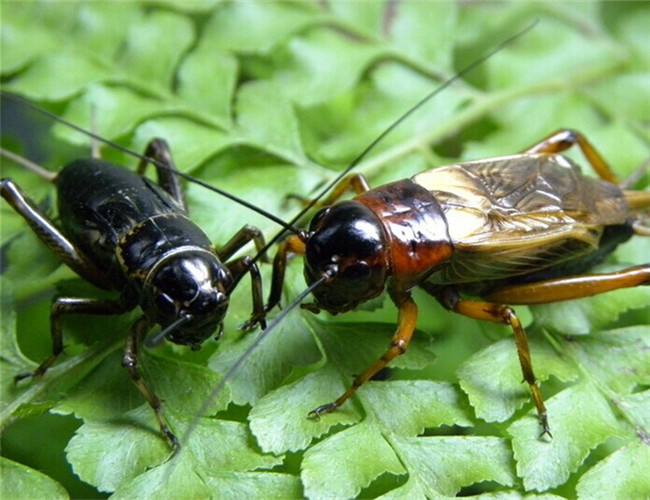
The cricket (Gryllulus; Gryllus) is called ‘ququ’ by many in China. In farmers’ eyes the cricket is a pest that damages crop growth. Males like to chirp and fight, with mutual killing. Females are larger, with a needle- or spear-shaped ovipositor exposed, and small wings.
In the cricket family, male and female crickets do not achieve ‘a happy marriage’ through ‘free love.’ Whichever male cricket is brave and good at fighting, defeating other males, gains possession of the female cricket, so ‘polygyny’ is common in the cricket family.
Chinese Name: Cricket
Chinese Alias: Ququ, Guoguo
English Name: Gryllulus; Gryllus
Binomial: Gobiodon okinawae
Kingdom: Animalia
Phylum: Arthropoda
Subphylum: Mandibulata
Class: Insecta (old name ‘Hexapoda’)
Subclass: Pterygota
Order: Orthoptera
Suborder: Ensifera (Long-horned suborder)
Family: Grylloidea, Gryllidae
Species: Cricket
Distribution: Widely distributed.
2 Cricket Physical Characteristics
Because crickets are found throughout the country, with thousands of different subspecies, individual differences are relatively large, but most crickets are small to medium sized, with a few large. Body color is almost all black-brown or black.
The cricket has a round head, wide thorax, and slender antennae. Chewing mouthparts. Some have well-developed mandibles, strong for fighting. Each tarsus has 3 segments; front and middle legs are similar and equal in length; hind legs are developed and good at jumping; the tympanum on the front tibia is larger outside than inside.
The ovipositor is exposed, needle- or spear-shaped, composed of 2 pairs of valvular plates. Both male and female abdomens have a pair of caudal filaments. The male abdomen has a pair of short rod-shaped cerci. Females are larger, with a needle- or spear-shaped ovipositor exposed and small wings. The male’s forewings have a sound organ, composed of a scraper, friction vein, and mirror on the wing veins. The forewings are raised and rubbed left and right, vibrating the mirror to produce a tone.
The cricket’s body is mostly barrel-shaped, with thick hind legs and filamentous antennae longer than the body. At the end of the abdomen there are two long caudal filaments; if it is a female, there is also an ovipositor longer than the caudal filaments. Another trick to distinguish sex: males have obvious concave-convex wing patterns, females have straight wing patterns. The most special thing is that its tympanum is on the front leg segment.
3 Cricket Living Environment
Usually crickets like dry environments, especially after adulthood; in the wild they like to inhabit places not easily seen by people, such as under bricks and stones, in soil holes, among grass. So when keeping crickets at home, how should you arrange their living environment?
An indoor dry environment is very beneficial to the cricket’s growth. When keeping crickets at home, frequently wipe and clean their living environment, to avoid the environment becoming too dirty over time, causing the cricket to get rotten-claw and rotten-whisker disease and lose its fighting ability.
Suitable living environment for crickets:
Choose a covered ceramic or wooden box, lay a layer of sand at the bottom, and a layer of loose soil on top, sand and soil.
Put a few stones or bricks inside the box, then place the box in an aquarium, add water to the dashed line to submerge part of the sand and maintain a constant water level, to keep the soil’s humidity and prevent eggs from drying out.
Use a thermostat to control the water temperature at about 25°C and humidity between 65%–75%, to maintain the environment the cricket needs to grow.
Crickets do not have the habit of caring for companions. To fight for territory and mates, crickets also attack and kill each other. To let crickets get along peacefully and grow healthily, the stocking density cannot be too high; ensure crickets have enough space for activity and territory, which is the best keeping method.
4 Cricket Feeding Guidelines
The cricket is an invertebrate, often appearing in summer grass, chirps at night, and is omnivorous, mainly liking to eat plants, especially tender buds, young leaves, and roots; vegetables and fruits are also their favorites.
Crickets living in the wild generally eat tender buds, young leaves, and roots, while captive crickets, in addition to various fresh vegetables and fruits, the keeper will also choose some foods, proportionally mixed into a rich nutritional meal. Feed at fixed times and amounts daily, to promote healthier and braver growth.
The main formula for making cricket food is: soybean powder 20%, coarse wheat flour 35%, corn flour 20%, skim milk powder 15%, liver powder 5%, dry yeast 5%; or corn flour 25%, soybean powder 20%, coarse wheat flour 25%, skim milk powder 15%, dry yeast 5%, fish meal 10%. Put the food in a container then grind finely and mix thoroughly.
When feeding each day, do not feed too much; just ensure the cricket can finish it all without leftover food. During feeding, the keeper can reasonably combine multiple foods to meet the cricket’s nutritional needs for growth.