Common Spider Tortoise
2 Photo Gallery

1 Overview
The spider tortoise is a forest-dwelling tortoise that adapts poorly to human keeping, with no captive-bred individuals sold; all in the market are wild-caught and demanding of their environment, so purchase with caution.
Chinese Name: Common Spider Tortoise (spider tortoise)
Aliases: spider tortoise
English Name: Common Spider Tortoise
Binomial: Pyxis arachnoides
Kingdom: Animalia
Phylum: Chordata
Class: Reptilia
Order: Testudines
Family: Testudinidae
Genus: Pyxis
Distribution: endemic to Madagascar.
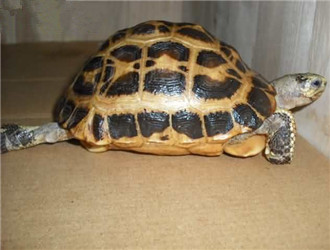
Appearance: adults 12 to 15 cm, a small tortoise; carapace with a glossy black ground and web-like bright yellow patterns; the plastron has a hinge joint between the humeral and pectoral scutes.
Habits: inhabits dry forest or dune areas 10 to 50 km from the coast; aestivates underground in the dry season.
Reproduction: oviparous; females usually lay only once a year and only one egg — a very low-yield tortoise, difficult to breed. Sexing is like other tortoises, mainly by tail.
Diet: tender vegetables and cattle dung.
2 Physical Characteristics
The spider tortoise is a small tortoise that grows very slowly (about 0.5 cm per year); its carapace carries messy, web-like markings, hence the name. The body is yellow, with inconspicuous leg scutes.
Adults are 12 to 15 cm; the carapace has a special glossy black ground with web-like bright yellow patterns, and a hinge between the humeral and pectoral scutes; patterns vary enormously. Because of its small size, most seen in the market used to be adults, but now imports are mostly juveniles. Some subspecies can close the shell (plastron and carapace). The limbs, head and neck skin are mostly black or yellow.
Hatchlings are very sensitive and timid — the less they are disturbed the better. Refusal to eat is common and disease mortality exceeds 50%, needing careful care. Adults are more active with bigger appetites. Some early legal adult imports were as robust as sulcatas. A few individuals’ patterns expand with growth and the base colour turns yellowish (called high-yellow abroad), more common in the nominate subspecies P. a. arachnoides.
3 General Care
The spider tortoise is widely regarded as a difficult tortoise, demanding of temperature and humidity, and needing a sense of absolute security, so do not disturb it often.
It does not hibernate; diet is 100% herbivorous; it likes an average humidity around 77%; temperature range 13 to 29°C; regular soaking or fixed drinking water is advised. Very sensitive to captivity, with highly variable shell patterns. Active in the morning, it seeks shade after sunrise and stops activity until late afternoon or the next morning. It does not need much space but likes to bury in substrate for a sense of security.
A rather timid tortoise, easily refusing food or dying from environmental change. It lives in arid climates but can also tolerate humid ones; because the native temperature range is large, it can withstand 10 to 40°C. Omnivorous leaning herbivorous but also eating slugs, earthworms and insects. Listed on CITES Appendix I, which prohibits capturing any wild individuals and illegal trade.
4 Captive Habitat
Individuals are small, so the environment need not be large, but the internal setup must be fine. Knowing it is demanding and very timid, place the tank in a quiet corner.
The best indoor enclosure looks like an upside-down bookshelf. For a single tortoise a reasonable tank is about 2 ft by 3 ft. The bottom should hold easily accessible food and water dishes and a nesting spot. A water dish is essential; for individuals unused to it, strongly soak them frequently until they learn to use it. A method: soak with a dish every day or every other day until they learn.
The water dish must be large enough to enter freely but shallow (about plastron depth) to avoid drowning. Because it comes from a higher-humidity region, use cypress or cedar bark or wood slivers as substrate to keep humidity. One corner holds a heat lamp with a hotspot of 32 to 38°C; another corner a UVB bulb — UVB is essential for converting vitamin D3 into calcium. A small box in a corner gives shade or escape from the hotspot.
5 Feeding & Diet
Omnivorous, but usually it eats only plant food; some studies show it may eat cattle dung, but only rarely, and wild scarcity is uncommon.
It should eat a high-fiber, high-calcium, low-protein diet to ensure digestive health and balanced growth. Avoid over-relying on supermarket vegetables, which often lack sufficient plant fiber and contain too much sugar. Dark leafy greens and weeds with a little surface moisture are the preferred morning food, also providing needed water. Chopped and mixed fruit, vegetables, mushrooms and other suitable plants give enough nutrition and prevent pickiness. Captive diet needs deeper study.
Extra calcium is vital for fast-growing or pregnant females. The spider tortoise does not hibernate in its native range, but becomes sluggish in very hot, dry or cold seasons. Unless it has experienced hibernation or you intend to breed, hibernation is not advised. For breeding incubation, environmental change inducing the female to dormant is a key step but must be carefully controlled and closely monitored.