Burmese Eyed Turtle
2 Photo Gallery
View All 5 Photos


1 Overview
The Burmese eyed turtle comes from southern Myanmar and occasionally appears in the Chinese pet market. Its price is reasonable and its appearance appealing; its only drawback is weak adaptability to new environments, so it often dies easily. Basically it is an aquatic turtle, foraging, mating, and sleeping in water, and is not difficult to keep. Occasionally it rests on land at night.
2 Physical Characteristics
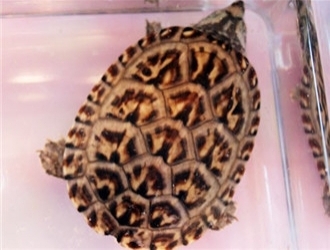
The Burmese eyed turtle’s carapace is pale green overall, with distinct black blotches resembling the patterns on a peacock’s tail — hence its name — and the back is highly domed. The limbs are strong but its swimming is only average, so in captivity the water level should not be too deep. Females are larger, with a flat plastron, short tail, and the cloacal opening inside the carapace edge; males are smaller, with a concave central plastron, long tail, and the cloacal opening outside the carapace edge.
3 Care & Maintenance
Although the Burmese eyed turtle does not belong to the high-domed turtle genus, its hatchlings have a very domed carapace, almost rivaling those of the Bengal eyed turtle hatchlings, flattening gradually with growth. Sexing is not easy: males have a more protruding, upturned carapace edge, a narrower and longer plastron, and a cloacal opening farther from the plastron’s rear edge; females have a rounder carapace, a broader plastron lobe, and a cloacal opening closer to the rear edge. Females lay 2–3 times a year, 3–10 eggs each time. Incubated at 30°C, they hatch in about 80–100 days. Hatchlings are born with eye spots and feed on leafy greens, growing quickly.
4 Natural Habitat
Generally the Burmese eyed turtle is not well suited to keeping in China, because the winter temperature swings are large and the turtle does not hibernate, easily leading to pneumonia. So if you wish to keep it, be prepared to use heating.
1. Temperature Needs of the Burmese Eyed Turtle
Because it is a Southeast Asian species whose native winters are warm, it has no hibernation habit. To help it safely through winter, deepen the water to 10–15 cm and install a heater, keeping the temperature at 25°C, with normal feeding and water changes. The temperature difference when changing water must not exceed 2°C — ideally also 25°C. It is suggested to install the heater from late October and remove it in mid-April of the following year.
2. Special Water Quality for the Burmese Eyed Turtle
The Burmese eyed turtle is not a difficult species, but it is prone to shell rot. Because its native water is acidic, after sunning the water add appropriate water conditioner and acidifier to maintain good quality and keep the water acidic. Every spring, as life revives, disease often arrives on schedule, so feed at fixed times and amounts — usually around 10 a.m. or 5 p.m. Also strengthen nutrition by adding multivitamins and minerals to food, or feed a variety of vegetables, for good results.
3. Treatment of Shell Rot in the Burmese Eyed Turtle
If shell rot has already set in, treat promptly as follows:
Use a (disinfected) small knife to cut open the affected scute, scrape out the yellow lesion (very foul-smelling) completely until healthy shell is exposed. Then apply potassium permanganate powder and place the turtle in a dry basin for one hour until the medication is fully absorbed, then return it to water; reapply every other day. After each feeding, give 3–4 drops of chloramphenicol eye drops daily for 10 consecutive days. Let the turtle sun for one hour each day to aid healing. Keep it dry at night and in lightly salted water during the day.
5 Care Guidelines
In captivity the Burmese eyed turtle can be kept in a glass tank or ceramic basin. Individual appetites vary; some sources say it preys on fish and shrimp in captivity, but some turtles are interested only in Indian lettuce, rapeseed, water spinach, romaine, cabbage, lettuce leaves, and beetle larvae (mealworms), ignoring fish and shrimp. Since it feeds mainly on plants, which are low in calories, it should be fed every day.