Buff-striped Keelback
2 Photo Gallery

1 Overview
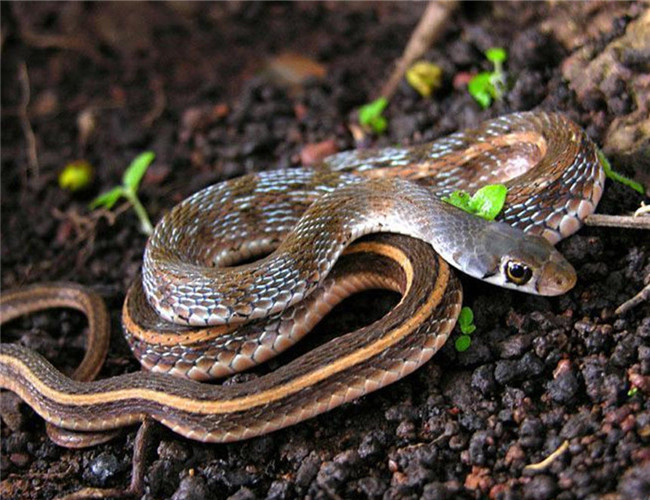
The Buff-striped Keelback is a small, non-venomous snake, maximum adult length about 90 cm, with interlaced gray-brown and yellow-brown patterns. It is diurnal and very gentle, but pesticide use in recent years has greatly reduced its numbers.
Chinese Name: Buff-striped Keelback (草腹链蛇)
Latin Name: Amphiesma stolatum
Alias: Yellow-head snake, grass keelback, flower wave snake, spotted-back snake
Classification: Chordata, Reptilia, Squamata, Serpentes, Colubridae (Natricidae), Amphiesma
Distribution: Indochina, and China’s Zhejiang, Fujian, Henan, Hong Kong, Hainan, Yunnan, Taiwan, etc.
2 Appearance
A small non-venomous snake, maximum adult length about 90 cm, diurnal. Because it is gentle and non-venomous, some hobbyists keep it.
Large individuals reach 600 mm. The head side and throat are yellow, hence the common name yellow-head snake. The dorsum is pale gray with black wavy cross-bands; on both sides of the bands are pale spots that look like two gray longitudinal stripes. Only the outermost dorsal scale row is smooth; 19 rows at the neck, 19 at midbody, 17 before the vent. Ventral scales 143–155; anal scale divided; subcaudals 68–82 pairs. It lives in plains, hills, and wet mountainous areas. Oviparous, 4–14 eggs per clutch. This snake has development potential; soaked in liquor it is called yellow-head snake and used medicinally.
3 Habitat
Although gentle, non-venomous, and of some medicinal value, captive keeping of this snake in China is not yet mature; market specimens are generally wild-caught and not for beginners.
In the wild it mainly lives in southern rural vegetable fields, paddy edges, fish-pond edges, near dwellings, in clear water with dense grass, often appearing in the morning and noon, basking on roads or stone walls. In captivity, build an environment similar to the wild.
4 Feeding
Captive keeping is uncommon, but because it is gentle and non-venomous some keep it. What to feed?
It starts eating easily — frogs and fish both work. After it starts, feed small frogs, occasionally fish; juveniles also eat insects. Price 30–100 yuan (some variant forms higher). It is active, so the cage should be longer than the snake; for its habits (raising the eating rate) line half the cage with grass and stones, the other half with water (not over the grass), adding small fish. But China’s pet-snake industry is immature; market specimens are wild, so not for beginners.