Black Tiger Snake
2 Photo Gallery
View All 9 Photos
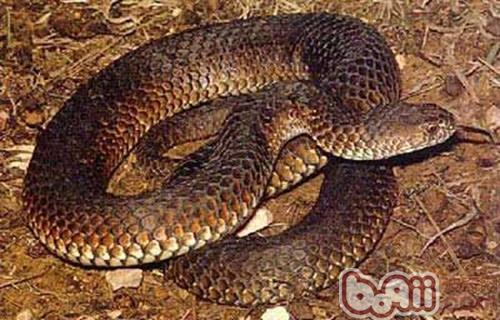


1 Overview
The Black Tiger Snake is one of Australia’s ten most venomous snakes, secreting potent neurotoxins, coagulants, hemolysins, and snake-specific myotoxins; its venom ranks among the world’s strongest, eighth in toxicity. It belongs to the family Elapidae, with scientific name Notechis scutatus, native to Australia. Its venom contains coagulants and neuromuscular blockers and is often fatal. Before striking, it flattens its head and neck like a cobra. It is common, abundant in southern swamps. The body shows various colors, usually brown and yellow stripes. Average length 1.2 m (4 ft). Generally not strongly aggressive; when threatened it flees if possible rather than attack. If cornered, it slowly flattens, tenses, raises its head, ready to strike; sometimes hisses to intimidate.
Chinese name: Australian Tiger Snake
Chinese alias: Australian Black Tiger Snake
English name: Black Tiger Snake
Binomial: Notechis sp.
Kingdom: Animalia
Phylum: Chordata
Subphylum: Vertebrata
Class: Reptilia
Order: Squamata
Suborder: Serpentes
Family: Elapidae (also called Elapidae)
Subfamily: Elapinae
Genus: Notechis
Species: Australian Tiger Snake
Distribution: Australia
2 Physical Characteristics
The Black Tiger Snake is about 1.3–1.6 m long. Its body is thick, head broad, body light dark orange or tea-colored with yellow-green, gray, or orange-brown bands. It lives in semi-arid regions of Australia and Tasmania. It is aggressive and highly venomous, a major cause of human deaths. It is a large venomous snake of Australia’s subtropical zones, a unique group within Serpentes with great variation in form, color, and size even within a species; some change color seasonally. Typically about 1.45 m with broad bands and clear light-dark contrast. Colors include olive, dark yellow, orange-brown, and black; the belly is lighter. It kills prey with venom and delivers fierce bites, capable of killing humans.
It tolerates low temperatures, but is most active on warmer nights. Females bear 12–40 young; one recorded Eastern Tiger Snake bore 64—rare. Generally not strongly aggressive; it flees if possible when threatened.
3 Care Guidelines
The Black Tiger Snake’s colors include olive, dark yellow, orange-brown, and black; belly lighter. It kills prey with venom and delivers fierce bites capable of killing humans. It tolerates low temperatures but is most active on warmer nights; females bear 12–40 young, one Eastern Tiger Snake once bore 64—rare. Generally not strongly aggressive; it flees if possible. If threatened, it slowly flattens, tenses, raises its head, ready to strike; sometimes hisses. Though abundant in southern Australia, its distribution is actually broad.
It secretes potent neurotoxins, coagulants, hemolysins, and myotoxins ranking among the world’s strongest venoms. After a bite, beyond severe wound pain, the toxin spreading from the wound causes pain in the feet and neck, numbness, sweating, then difficulty breathing and partial paralysis. Even with effective antivenom, without immediate treatment the fatality rate reaches 45%.
4 Natural Habitat
The Black Tiger Snake is born in semi-arid regions of Australia and Tasmania, living in dunes, beaches, and grass; it eats amphibians, birds, and small mammals, and is viviparous (live-bearing). It is aggressive and highly venomous, a major cause of human deaths. It is a large venomous snake of Australia’s subtropical zones, a unique group with great variation; some change color seasonally. Treatment for bites by Australian venomous snakes is broadly similar; to curb venom spread via lymph, the initial step uses the Pressure Immobilization Method.
Treatment wraps a broad bandage near the wound and tightly binds the whole limb, splinting it. If marks remain near the bite, the venom may be identified for targeted treatment. Antivenom greatly reduces tiger snake fatalities; deaths from tiger snake bites have now been surpassed by those from brown snakes.
5 Feeding Requirements
The Black Tiger Snake eats amphibians, birds, and small mammals, and is viviparous. Native to Australia, its venom contains coagulants and neuromuscular blockers, often fatal. Before striking it flattens head and neck like a cobra. It is common, abundant in southern swamps; body various colors, usually brown and yellow stripes; average 1.2 m (4 ft). Most active on warmer nights; females bear 12–40 young, one Eastern Tiger Snake once bore 64—rare. Generally not strongly aggressive; it flees if possible.
It secretes potent neurotoxins, coagulants, hemolysins, and myotoxins ranking among the world’s strongest venoms. After a bite, beyond severe wound pain, the toxin causes foot and neck pain, numbness, sweating, then difficulty breathing and partial paralysis. Even with effective antivenom, without immediate treatment the fatality rate reaches 45%.