Asian Leaf Turtle
2 Photo Gallery

1 Overview
The Asian leaf turtle (Cyclemys dentata) is a fairly common semi-aquatic turtle; both price and difficulty suit beginners, and it is lively and interactive with people.
It occurs from India to Indochina, south through the Malay Peninsula and Indonesia to Bali, Borneo and the Philippines, and in Yunnan and Guangxi, China, usually in lowland streams up to 1,300 m. Type localities: India, Bangladesh and Java.
SOURCE NOTE: the source listed the English name as ‘AsianLeaf Turtle’ and gave the binomial Cyclemys dentata. Four subspecies are recognised: C. atripons (Beautiful leaf turtle), C. dentata (Asian leaf turtle), C. oldhami (Oldham’s leaf turtle) and C. tcheponensis (Assam leaf turtle). In captivity it is largely carnivorous – fish, shrimp, meat.
2 Appearance
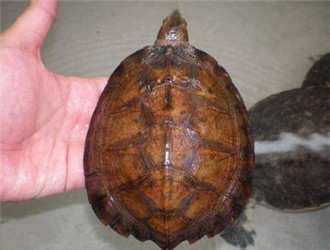
Identification is tricky because of four subspecies differing mainly in carapace and neck pattern (radiating, mottled, or plain). Adults reach 20-24 cm; the carapace is slightly flattened, juveniles as long as wide, adults longer than wide; the central keel is obvious in juveniles and fades with age; the rear margin is serrated, especially in young. The narrow plastron has a 3-notch rear; a short obvious bridge; adults develop a plastral hinge.
It has three well-developed keels, brown overall (tan to red-brown to near-black). Plastron tan or brown with dark blotches per scute. As a box-turtle-group member it can close its plastral hinge. Colour varies widely; typically both shell halves are brown with black radiating lines on the plastron.
3 Care & Temperament
Easy to keep as semi-aquatics go, but watch the usual pitfalls. Lives in lowlands; juveniles more aquatic, adults more terrestrial bottom-walkers. When picked up it defecates (like many tortoises).
It is one of the most land-leaning semi-aquatics – keep it on damp soil or sand with leaf litter (mimic Guangxi or Hainan hills), not deep water, or it easily gets shell rot. Temperature about 25 C is best; brumates at 17 C.
4 Habitat & Environment
Juveniles: 5-10 cm water with a rock basking spot, about 20-gallon tank, good filtration (shallow water makes filtration hard – use a submersible or strong filter plus frequent changes). Basking spot about 32 C under a reflector; full-spectrum UV (UVB and UVA) lamp – mercury vapour is best. Add live or plastic plants for cover.
Adults: at least 50% land; water deep enough to reach the surface while standing. Outdoor kid-pool setups work well in warm seasons.
5 Diet & Feeding
Not fussy: wild diet includes figs, fruit, carrion, fish, crustaceans; captives take the same. Do not overfeed – obesity is common. Adults 2-3x weekly, fast-growing juveniles daily or every other day; they quickly accept commercial turtle pellets.
Sensitive to temperature swings (feeds little at 20 C, brumates at 17 C, ‘summer-sleeps’ at 35 C). Change water warmer than before in late autumn to avoid gut disease. Watch for ‘sudden death’ syndrome in new imports – choose healthy individuals, keep humidity right (too dry means head peeling; too wet means shell rot), and supplement calcium.