Amboina Box Turtle
2 Photo Gallery

1 Overview
The Amboina box turtle (Cuora amboinensis) is the most common and cheapest of the seven Asian box turtles, so many keep it. A semi-aquatic turtle of streams, marshes and lowland wetlands; in captivity keep water no deeper than the shell height, and in late autumn/early spring keep it on sand rather than water.
SOURCE NOTE: the source gave the binomial Cuora amboinensis, retained here. In the wild it is a strict vegetarian, but in captivity it readily takes fish and lean meat.
2 Appearance
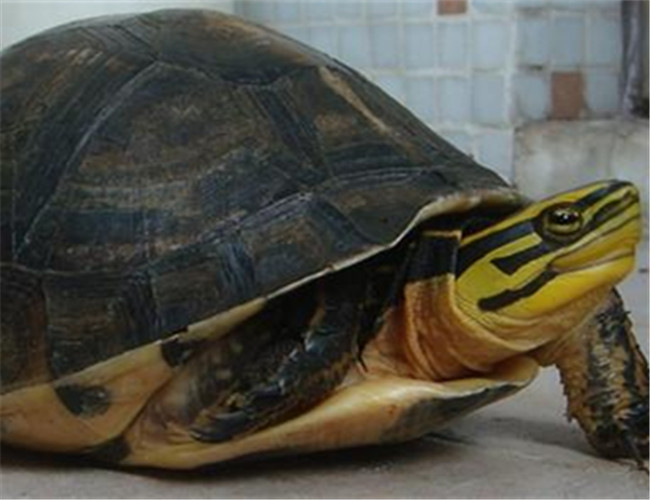
The ‘Malayan box turtle’ has a dark carapace and yellow facial stripes – a striking contrast. It has a fully developed plastral hinge and can close completely. The smooth, high-domed olive/brown/near-black shell has a central keel (extra keels in juveniles). The plastron is yellow/cream with a large black blotch; the face has yellow longitudinal stripes. It is the only Borneo turtle with a complete hinge and cannot be confused with others.
3 Care & Temperament
Very shy – at any noise it withdraws fully for 30+ minutes and may stay in one pose for days. New imports need a quiet, dim spot and 2-3 weeks to start eating (lean meat, banana, water at 25 C+; stops at 18 C, brumates near 15 C, minimum 10 C). The most water-loving box turtle: keep water just over the shell so it can surface easily, with ~30% land of rock/sand for basking. Give 1-2 h natural sun or UVB daily; heat the winter (it does not truly brumate).
4 Habitat & Environment
The most aquatic of the box turtles, like a pond turtle, but tolerates brief deep water. Native to equatorial rainforest, so sensitive to dryness (yet basks when dry). Keep water at 1/3 depth; wild ones haunt marshes and streams. Sensitive to temperature: at 5 C prolonged it gets sick; feeds normally at 22-25 C (optimal 25 C).
5 Diet & Feeding
Although amphibious, it prefers to eat in water, so water quality and filtration matter. Wild adults are strictly herbivorous (aquatic plants), but captives easily accept fish and meat – too much animal protein risks kidney failure. Safest diet is mostly plants/fruit with a little meat: duckweed, algae, leafy greens, cabbage, plus occasional lean meat, insects, snails. Hatchlings are more carnivorous, shifting to plant-heavy with age.