Map Turtle
2 Photo Gallery
1 Overview
Map turtles are common but variable – some forms are widespread in the Chinese market, others rare. Many subspecies with a wide appearance range make identification tricky.
They are freshwater turtles of eastern US and southern Canada, resembling sliders and cooters but smaller with a midline keel; the shell pattern looks like a map (hence the name). Lifespan up to 15-20 years. The common market forms are the Mississippi map turtle (Graptemys pseudogeographica kohnii) and the false map turtle (G. pseudogeographica pseudogeographica).
2 Appearance
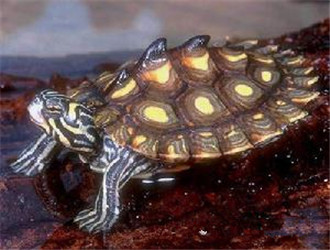
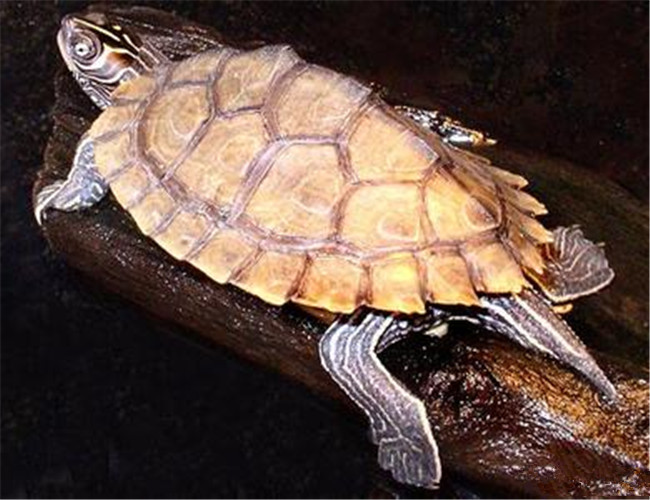
Body shape like sliders and painted turtles, but with a prominent midline keel that in many species becomes a backward-projecting spike or knob – giving the alternate name ‘sawback’. Rear marginals serrated. Some have huge heads and jaws to crush snails. The fine lines on skin and scutes look like contour or road maps – unique among turtles.
Sexing: males have longer thicker tails with the vent beyond the shell edge and elongated front claws; adult females equal or exceed the largest males.
3 Care & Temperament
Captive breeding succeeds, but map turtles are less common as pets than sliders or painted turtles, often single males. They do well if correctly kept. Unlike other water turtles they tolerate poor water quality poorly – keep water pristine.
Their limited ranges make them vulnerable; habitat degradation, agricultural or industrial runoff and riverside development all hit them. Collecting wild (especially rare forms) depletes populations. Protecting only their sites is insufficient because they live in flowing rivers where upstream events outside reserves matter.
4 Habitat & Environment
Habitat varies by species: many prefer rivers (some confined to a single river system); G. geographica, G. ouachitensis and G. pseudogeographica also use ponds or swamps with dense aquatic vegetation. Others (G. versa, G. nigrinoda, G. flavimaculata, G. oculifera) live in faster sandy or clay streams. Ample basking sites are essential.
5 Diet & Feeding
They eat aquatic clams and snails (hence the strong jaw and ‘teeth’ to crush shells). In mixed tanks they may bite the tails or necks of gentle tankmates – best kept with North American turtles. In captivity they eat anything and grow fast; care resembles sliders or painted turtles but with stricter water-quality needs. More captive-bred individuals will reduce wild depletion.