Narrow-bridged Musk Turtle
2 Photo Gallery
1 Overview
Also called the narrow-bridge musk turtle, it is a top-tier member of the mud-and-musk turtle group — expensive, fierce and fun to keep, earning the nickname king of the egg turtles. It is aquatic and tolerates deep water, but drowning is still possible.
Chinese Name: Narrow-bridged Musk Turtle (narrow-bridge box turtle)
Aliases: narrow-bridge musk turtle, narrow-bridge box turtle
English Name: Narrow-bridged Musk Turtle
Binomial: Claudius angustatus
Kingdom: Animalia
Phylum: Chordata
Subphylum: Vertebrata
Class: Reptilia
Order: Testudines
Family: Kinosternidae
Subfamily: Staurotypinae
Genus: Claudius
Distribution: central Veracruz and northern Oaxaca, south through northern Guatemala to Belize City, excluding the Yucatán Peninsula.
Appearance: brown carapace, each vertebral and costal scute covered with black radial patterns, marginal scutes with small brown spots. Pale yellow plastron with 8 scutes, lacking gular and humeral scutes.
Habits: aquatic, inhabiting the shallow shores of lakes, swamps and rivers.
Reproduction: oviparous; nests dug in the dry season, from November at the latest to February of the following year; the irritable turtle may attack then. Several clutches may be laid, usually 2 to 3 hard-shelled elliptical eggs each.
Diet: carnivorous, feeding on frogs, invertebrates and fish.
Price: usually around 5000 yuan.
2 Physical Characteristics
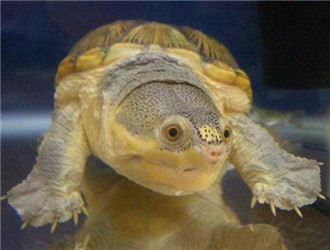
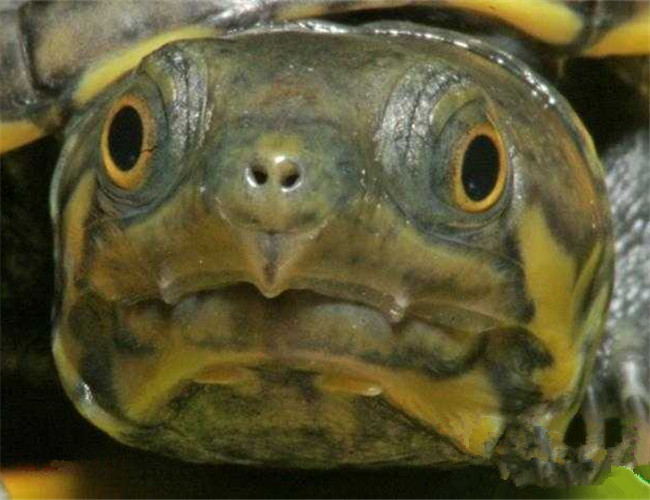
A medium-sized aquatic turtle with an arched, rounded carapace that looks like an egg from above. The head is large and the mouth is parrot-like; the temperament is fierce and the bite painful, so do not hand-feed.
The body is about 16.5 cm, elliptical; three longitudinal dorsal keels fade with age. The rear marginal scutes are not serrated or flared. The plastron connects to the carapace by ligaments. Axillary and inguinal scutes are absent; the plastron lacks gular and humeral scutes; the front and rear of the plastron are triangular, the same yellow as the bridge.
Hatchlings have a black midline stripe on the plastron spreading along the seam; the huge head has a slightly protruding mouth, a hooked upper jaw with a pair of spines below the front of the orbit, and a long hooked lower jaw. The small round or oval beak extends back to the orbit, with a pair of barbels on the chin. The cheek bone does not contact the squamosal, and the preorbital is not part of the orbit. The head is yellowish-brown or grey with black patches, the throat pale yellow, and the neck bears grey rows of small warts.
3 General Care
Individuals vary greatly in colour and pattern. First choose promising hatchlings, then fine-tune care to bring out the colour. Water quality, temperature, food, light and environment all directly affect or change the turtle’s colour; by observing colour you can visually judge its health. When digesting after a meal, when the environment suddenly changes, when startled, or while basking, the colour shifts subtly — this is its trait, communicating with its owner through colour.
4 Captive Habitat
It does not hibernate and demands fairly high temperatures, ideally 25 to 30°C. It loves basking; if heat is insufficient, use a heat lamp to meet its basking need.
The tank is custom-built, 80 cm long, 60 cm wide and 50 cm high. Do not use a glass-tube thermometer — the turtle’s mouth is sharp and easily bites it, causing needless trouble. Use an external strong filtration system. No substrate is best, since the turtle eats a lot and may ingest it; this also makes cleaning easy.
For hatchlings, water just over the carapace is enough; for subadults or adults, 4 to 6 times the carapace depth. Its swimming is decent, so a resting platform in the water is necessary for sleeping and basking — driftwood or smooth large pebbles work well. Avoid mixing with others to prevent needless injury.
Water quality is not demanding; it quickly adapts to ordinary home tap water that has been aired, but never use water straight from the tap. As a highly aquatic species, use a filter so its scent in the water gives it a sense of security and eases cleaning and maintenance.
5 Feeding & Diet
It is omnivorous but leans carnivorous; in the wild it occasionally preys on frogs, so when keeping it, offer preferred meats for basic energy and also some plant food for micronutrients.
Food selection: a broad diet of both animal and plant feeds; for fast growth, animal feed 70 to 80% and plant feed 20 to 30%, plus multivitamins, trace elements and calcium/phosphorus minerals. The ratio of animal to plant feed should be 7:3 or 8:2. Feed must be fresh, prepared and fed the same day; never feed spoiled food. Adjust quality and quantity by growth stage and climate.
Feeding notes: July to September is the peak feeding and weight-gain period, so supply ample nutrition then. In spring and autumn, when temperatures are lower, it prefers to feed around midday, so feed before noon. In summer it is active and feeds in the evening (17:00 to 19:00). Near hibernation, increase feeding to fatten the turtle for overwintering.