Golden Python
2 Photo Gallery
3 Breed Introduction
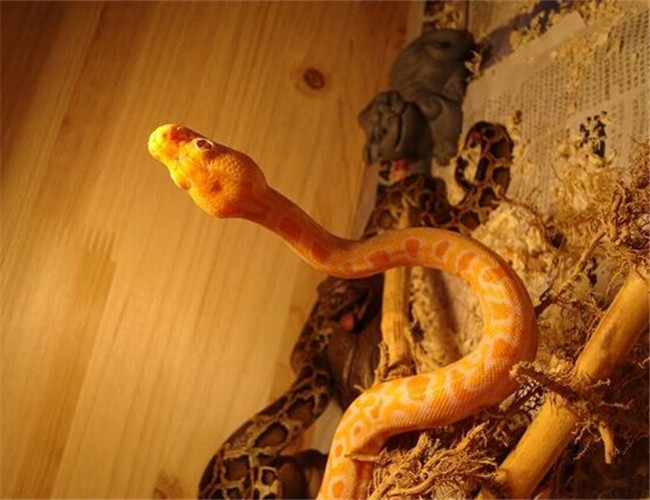
The Golden Python — revered almost as a sacred creature across parts of its native range — is in fact a rare mutation of the Burmese python. Adults reach an impressive length, and their coloration is striking: a uniform golden to creamy white with little to no pattern.
In the wild, golden morphs cannot survive: the mutation is essentially a disorder in which the animal lacks melanin, leaving it immunocompromised and disease-prone, stripped of its natural camouflage, and vulnerable to fatal UV overexposure. Every individual alive today is captive-bred. Taxonomy: Kingdom Animalia; Phylum Chordata; Class Reptilia; Order Squamata; Family Boidae; the species is the Burmese python (Python bivittatus). Native distribution: India, Sri Lanka, Myanmar and northern Thailand, where it inhabits monsoon forests, dry woodlands and savannas.
5 Habitat & Living Environment
Golden pythons are generally placid but can and do bite, and there are documented cases of large individuals injuring or even killing people, so they should be acquired and tamed young. They thrive in warm, humid conditions and enjoy soaking, which makes Taiwan-style climates suitable — but because they are true pythons that readily reach 5 metres (16 ft), they are not practical for the average home and prospective keepers should think carefully before committing. A proper setup needs three things. First, an escape-proof, easy-to-disinfect enclosure with no sharp protrusions, with good ventilation and heat retention. Second, a heat mat: the snake needs an ambient temperature of 26–33°C (79–91°F) to stay healthy, so heating is essential. Third, a water basin: the python sheds every 3–6 weeks, and any retained old skin should be loosened by soaking the animal in 30°C (86°F) warm water.
6 Care & Husbandry
Golden pythons grow quickly and, despite a forbidding appearance, are mild-tempered. Their upkeep cost rises with their size — feeding alone is a serious consideration, and so is their value, which climbs along with their weight. Given enough cleanliness, regular feeding and an understanding of their habits, they make rewarding pets. They drink water daily and, after a single meal, take 1–2 weeks to digest. Feeding is undeniably visceral: a rat placed in the enclosure is coiled and constricted until its bones are broken and it becomes a compact ball, which the snake then swallows whole; occasionally the prey can be heard squeaking faintly inside the body. Golden pythons eat whole mammals such as rats and rabbits, so a keeper must be comfortable with this side of the food chain before bringing one home.