Geoffroy’s Side-necked Turtle
2 Photo Gallery
View All 8 Photos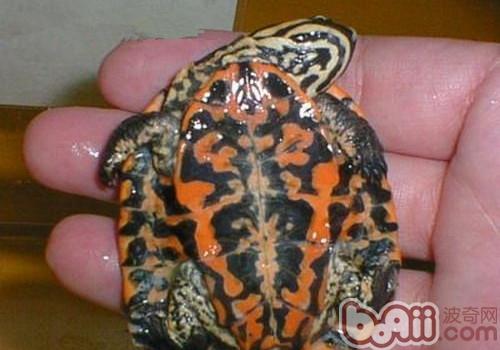
1 Overview
The Geoffroy’s side-necked turtle, also called the frilled side-necked turtle, belongs to the family Chelidae, genus Phrynops, and is distributed in South and North America. Shy and usually nocturnal, it is a turtle that never likes to bask and prefers the dark.
Chinese name: Geoffroy’s Side-necked Turtle
Scientific name: Phrynops geoffroanus
English name: Geoffroy’s Side-necked Turtle
Aliases: Frilled turtle, Geoffroy’s toad turtle
Kingdom: Animalia
Class: Reptilia
Order: Testudines
Family: Chelidae
Genus: Phrynops
Species: Geoffroy’s Side-necked Turtle (Phrynops geoffroanus)
Distribution: Brazil, Argentina, Colombia.
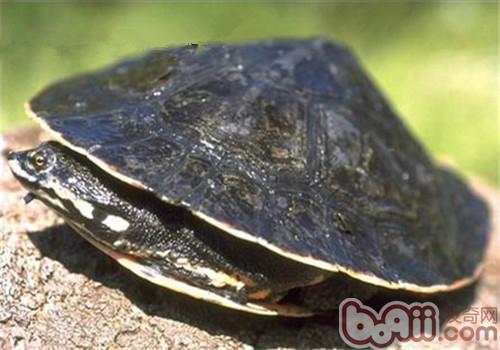
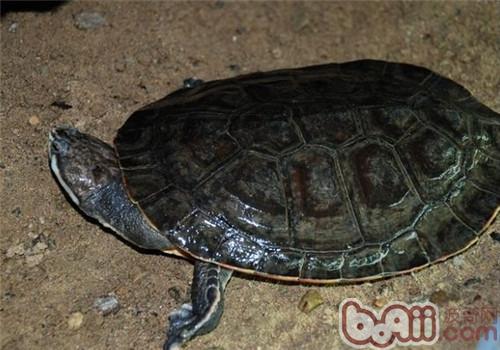
Appearance: Carapace gray-brown, oval, flattened on top.
Habits: One of the larger Phrynops; carapace up to 35 cm. Aquatic, living in vegetated lakes, rivers, and marshes.
Diet: Small animals such as small fish, worms, and snails; in captivity it likes small fish and mixed feeds.
Reproduction: Oviparous.
2 Physical Characteristics
The Geoffroy’s side-necked turtle is a small aquatic species, usually with a black or dark carapace. Generally a turtle’s carapace shade relates to sunlight, but this species’ color does not change with light, and it dislikes basking.
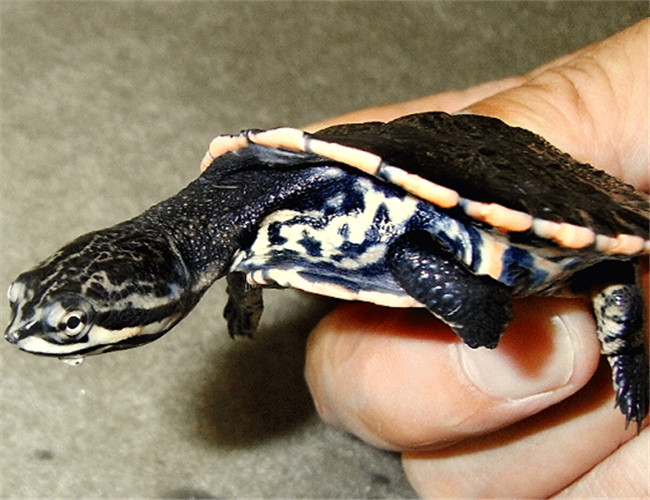
Its carapace is gray-brown, oval, flattened on top. The plastron is gray-yellow with unspotted scutes; the intergular scute separates the gulars but not fully the humerals. The head is broad, gray, flat, and scaled, with two pale-yellow stripes behind the eyes extending to the back of the head; the throat and neck underside are gray-white, and the lower jaw has a pair of gray-white barbels. Limbs are gray above and below with well-developed webbing; front feet have 5 claws, hind feet 4. The tail is short.
The carapace is small, adults maxing at only 20 cm. Sex is easily told: males have a concave plastron and a longer, larger tail than females.
3 Care & Husbandry
These turtles are very secretive, so mating is rarely observed and cannot be described in detail here. Mating seems to occur year-round. Three females nested at night in burrows 10–15 cm deep. Most often 4–5 eggs are laid from September to January, with some in February–March. After about four years, clutch size increases, presumably as they adapt better to captivity.
4 Natural Habitat
The enclosure should be as large as possible, especially for multiple turtles—not because they fight, but because their water is hard to keep clean; a larger setup better protects water quality.
For 3–4 turtles, an indoor tank of 165×125×45 cm (L×W×H) works; one or two can have less. Although aquatic, they cannot stay in water constantly, so provide land—a 60×40 cm box filled with 23 cm of sand and soil. From July to November, lower water to half and raise temperature to 26–27°C to mimic the dry season and stimulate breeding.
From December to June, mist the tank daily to mimic the rainy season, keeping water at 24–25°C. During this period they prefer to stay in water. Turtles need water and water needs cleaning; even with a filter, change it about weekly. Adding some peat to the water greatly reduces fungal growth and prevents skin rot.
5 Care Guidelines
The Geoffroy’s side-necked turtle is fairly omnivorous. Wild diet is hard to observe, but in captivity you can vary the diet to learn its preferences, ensuring nutrition and variety.
It is very shy and emits a distinct odor when disturbed. It inhabits swamps, streams, pools, and small rivers. Rarely seen in the wild because it is nocturnal and active at night—and, importantly, it dislikes basking. Without sunlight it looks rather dark and plain, but with familiarity you find it has a certain charm despite its homely looks.
In keeping them, diet is most important. They eat both meat and plants; wild life is harsh so they rarely get meat and lean vegetarian, while captives lean omnivorous—feed beef, insects, snails. A common trait: they dislike lettuce.