Search Results
1584 results for “type 2”

Lin’s Butterflyfish
The Lin's Butterflyfish resembles other butterflyfish but is named for a black sickle-shaped band, also called Scythe Butterflyfish. Minimum tank 265 liters.

Scythemarked Butterflyfish
The Scythemarked Butterflyfish resembles other butterflyfish but is named for a black sickle-shaped band, also called Scythe Butterflyfish. Minimum tank 265 liters.

Blue Gourami
The Blue Gourami is not hard to keep; its greatest feature is that the pelvic fins have degenerated into long filaments, earning it the name threadfin gourami. Large-bodied, it needs a sizable tank and, being quiet, benefits from planted tanks.

Triangle Rasbora
The Triangle Rasbora, also called the Harlequin Rasbora, is a cyprinid. At 24–28°C its appetite is strong and growth rapid. Gentle, it gets along with other fish but not large ones.

Blue Oranda
The Blue Oranda is a goldfish variety, distinctive for its sky-blue or pale-blue body, hence popular. As a goldfish it is easy to keep and not demanding about water.

Golden Monkey Flowerhorn
The Golden Monkey Flowerhorn is a Flowerhorn strain with the eyes of the Gold Flower line. Its greatest feature is a body red in the front half and golden-yellow in the back. It is now a beloved variety.

Tomato Clownfish
The Tomato Clownfish is a common clownfish variety; the hero 'Nemo' in Finding Nemo is this species. Because it is smaller than other clownfish, a tank of at least 90 liters is recommended.
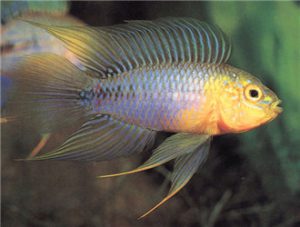
Borelli’s Dwarf Cichlid
The Borelli's Dwarf Cichlid is one of the more distinctive dwarf cichlids. Like other dwarfs it tolerates low temperatures and is not demanding about water quality, so it is easy to keep.
Festive Cichlid
The Festive Cichlid, also called the Black-brow fish, is native to the Amazon River basin. It has a very distinctive appearance, reaches about 15 cm, and looks much like the Jaguar cichlid. It is named for a black diagonal stripe resembling an eyebrow.

Yellow Oranda
The Yellow Oranda is a goldfish variety. Because goldfish varieties are so varied and still being hybridized, hobbyists with little experience may confuse them, but the Yellow Oranda has distinctive features. Its head growth is especially notable.