Search Results
98 results for “blue eye”

Magpie Goldfish
The Magpie Goldfish, short for 'Magpie', has a blue-based body color and is named for its overall resemblance to a magpie. It mostly derives from blue goldfish such as the Blue Oranda or Blue Dragon Eye.

Whitecheek Tang
Also called the Clown Tang or Gold-rim Tang, the Whitecheek Tang has a purple-blue body and a blue tail with yellow stripes, making it very attractive. Its care is moderately difficult and not for beginners; a tank of at least 300 liters is required.

Head and Tail Light Tetra
Also known as the Lantern Fish, Head-lamp Fish, or Signal Fish, the Head and Tail Light Tetra is small but very distinctive; under lighting, the golden-yellow spots near its eyes and tail reflect golden and red colors, which is quite beautiful.

Maroon Clownfish
The Maroon Clownfish (Premnas biaculeatus), also called the Spine-cheek Clownfish, is a common clownfish native to coral reefs of the Indian and Pacific Oceans. Adults reach 10 to 15 cm and are marked by three silvery-white bands across the body. In the wild it forms a close, mutually dependent symbiosis with sea anemones.

Paucis Dwarf Cichlid
The Paucis dwarf cichlid was earlier called the blue lyretail dwarf cichlid, later renamed from a foreign translation. Males show a bright pale-blue metallic sheen, very pretty, but both keeping and breeding are very hard.
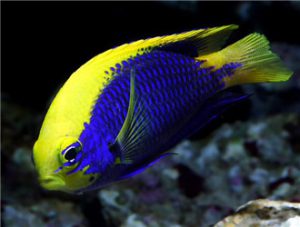
Starck’s Demoiselle
The Starck's demoiselle has a very distinctive look: its head and sides are vivid blue, and the dorsal, pectoral, and caudal fins are yellow. In the wild it lives near rock outcrops or crevices on the outer slopes of sandy-bottom channels.
Saddle Valentini Puffer
The saddle Valentini puffer, also called the black-saddle puffer, lacks pelvic fins, but this does not stop it swimming freely in the tank. When startled, such as by a net, it inflates to protect itself.

Green Spotted Puffer
The green spotted puffer is a pufferfish living in near-coastal freshwater or brackish water, with a very special look. Shortened to GSP, adults reach about 10 to 18 cm and are classed as brackish-water fish.

Japanese Tang
The Japanese tang has beautiful color, a gentle temperament, and strong adaptability, doing well in both fish-only and reef tanks. Captive care needs a tank of at least 300 liters to give it enough swimming room.

Honey Gourami
The Honey Gourami, commonly called the Lalius, is relatively easy to sex by appearance. Not demanding about water and gentle, it can be mixed with other similar temperate tropical fish.