Japanese Akita
2 Photo Gallery
View All 5 Photos


1 Breed Introduction
Japanese Akita (detailed introduction)
The Akita originated in the 17th century and is named after Akita Prefecture. They are calm, confident, gentle, easy to train, loyal to master and family, and very steady. In Japan they were used as fire-watch dogs and are now popular family dogs worldwide; in Japan they are beloved as the most popular breed.
The original Japanese dogs were small to medium, with no large variety. Since 1603 in the Akita region, the Akita (medium bear-hunting dog) was used for dog fighting. From 1868 the Akita was crossed with Japanese fighting dogs and Mastiffs, increasing its size but losing fox-dog traits. In 1908 dog fighting was banned, but the breed was preserved and refined into a large Japanese breed. Finally, in 1931, nine top examples were designated ‘Natural Monuments’.
In 1931 it was officially recognized as a Japanese national treasure, and so became widely popular in Japan.
2 Physical Characteristics
Japanese Akita (detailed introduction)
The Akita belongs to the spitz family, strong and muscular, and loves exercise. Overall it looks robust, well-proportioned and elegant, with a compact, well-balanced structure. Females are slightly longer-bodied than males; males stand about 26-28 inches, females about 24-26 inches.
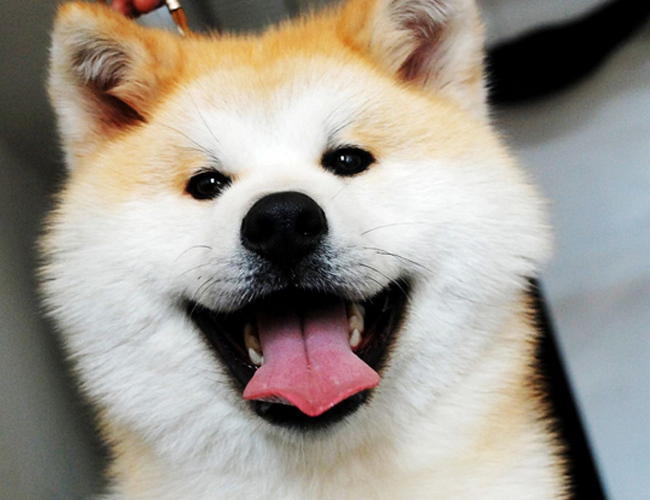
The head is large but in proportion to the body, with few wrinkles; from above the head outline is a blunt triangle. The eyes are dark brown, small, deep-set and triangular, with black rims. The nose is broad and black. The ears are triangular with slightly rounded tips, wide at the base and set wide apart; they stand firmly and are small. The lips are black and not pendulous; the tongue is pink and the teeth strong.
The neck is thick, muscular and short; the body length slightly exceeds the height; the ribs are well sprung with developed chest muscles. The shoulders are strong and powerful; the hindquarters are broad, muscular and equal in bone to the front; the front dewclaws are usually not removed, while the hind ones are. The tail is large and full, set high and curled over the back.
The Akita has a double coat: a thick, soft, dense undercoat slightly shorter than the harsh, straight outer coat that stands off the body. The coat is relatively easy to groom.
The Akita moves with a brisk, powerful, quick stride and is a very active breed, so owners should give it plenty of exercise to keep it fit.
3 Temperament
Japanese Akita (detailed introduction)
The Akita is gentle and affectionate with its master but somewhat aggressive toward other animals. It is good at retrieving game shot by hunters from snow or water. As a large breed it is strong, so train it as a puppy to stay by your side; over time this becomes a habit and it can later go without a leash.
The Akita is very loyal to its master; the film ‘Hachi: A Dog’s Tale’ beautifully shows its fine qualities, and many came to like the breed through that movie.
4 Care and Grooming
Japanese Akita (detailed introduction)
The Akita is calm, gentle, strong and brave, and easy to train. As a former hunting dog that loves to run, it retains some wildness, so don’t keep it indoors for long. Take it out for walks and jumps. Also mind hygiene; the Akita is prone to heartworm, so watch it outdoors and stop it from scavenging food off the ground.
Though gentle with its master, the Akita is aggressive toward other animals, so as a puppy expose it to strangers and other animals to build tolerance.
Its coat is fairly easy to groom; brush it every few days or wipe with a warm towel. Grooming removes loose hair and boosts circulation, so daily care is worthwhile.
5 Feeding Guidelines
Japanese Akita (detailed introduction)
For any dog, feeding is key; correct feeding directly affects health. What to watch in feeding? A good environment matters greatly. Wash and sun the dog bed often, because the Akita’s skin resistance is not great; allergic dermatitis, sebaceous adenitis and canine herpesvirus are common, so keep its living space clean.
Also wash and disinfect the feeding bowl often; neglecting it breeds bacteria, especially in summer when parasites peak, so keep your own disinfectant and regularly sanitize the bowl and bedding.
The Akita is fairly easy to train; repeat reminders and it will remember. Train with a calm, gentle tone, not harshly, so as not to scare it. Trained well, it will be an excellent family dog.